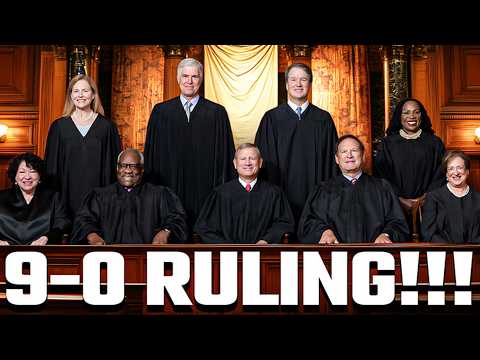
NOW DEVELOPING! Supreme Court Issues 9-0 Unanimous Decision With Major Nationwide Impacts!

Published on February 7, 2026
Duration: 9:33

This video provides a critical legal analysis of the Supreme Court's unanimous decision in Martin v. United States. The speaker, an expert in constitutional law, details how the ruling limits the FBI's ability to claim immunity under the Federal Tort Claims Act for botched raids, emphasizing the distinction between policy decisions and ministerial duties. The analysis highlights the potential for increased accountability in law enforcement actions.


Quick Summary

The Supreme Court's unanimous 9-0 decision in Martin v. United States clarifies that law enforcement immunity under the Federal Tort Claims Act requires decisions to be grounded in legitimate policy choices. This ruling limits the government's ability to claim the 'discretionary-function exception' for botched raids, emphasizing the distinction between policy decisions and ministerial duties like executing warrants correctly.

Chapters

  1. 00:00Introduction to Botched FBI Raid Case
  2. 02:12Background of Martin v. United States
  3. 03:47Supreme Court's 9-0 Decision
  4. 04:12DOJ's Current Legal Strategy
  5. 05:23Plaintiffs' Response and Ministerial Duty
  6. 06:43Implications for Law Enforcement Accountability

Frequently Asked Questions

What was the Supreme Court's decision in Martin v. United States?

The Supreme Court issued a unanimous 9-0 decision in Martin v. United States, ruling that the 11th Circuit applied the 'discretionary-function exception' too broadly. The decision clarifies that law enforcement immunity under the FTCA requires decisions to be grounded in legitimate policy choices.

How does the Martin v. United States ruling affect FBI raids?

The ruling limits the government's ability to claim immunity under the Federal Tort Claims Act for botched raids. It emphasizes that mistakes in executing warrants, like raiding the wrong house, are not automatically protected by the 'discretionary-function exception' unless tied to a valid policy decision.

What is the difference between a discretionary function and a ministerial duty in law enforcement?

A discretionary function involves judgment and policy considerations, potentially shielding actions from liability. A ministerial duty is a required action performed without personal discretion, such as executing a warrant at the correct address, which is not typically covered by immunity exceptions.

What are the potential implications of the Martin v. United States decision?

The decision could lead to increased accountability for law enforcement agencies in cases of botched raids. It may make it harder for the government to avoid lawsuits by broadly claiming 'discretion' for operational errors, providing more legal recourse for victims.

Related News

All News →

More 2nd Amendment & Law Videos You Might Like

More from Armed Scholar

View all →