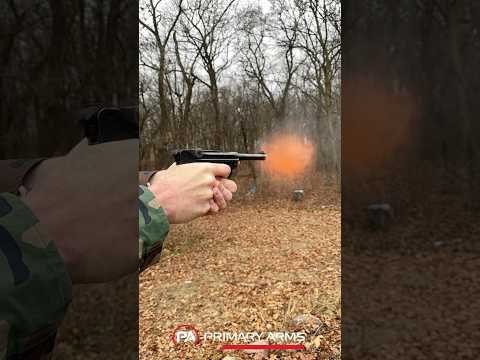
How Does It Work: Toggle Actions

Published on June 3, 2021
Duration: 3:01

This guide breaks down the mechanics of toggle action firearms, explaining their function as locking mechanisms in iconic early self-loading weapons like the Luger, Maxim, and Vickers. It details the 'knee joint' principle, the unlocking sequence in short recoil and delayed blowback variants, and the historical reasons for their obsolescence. The explanation is delivered with expert analysis from Ian McCollum.


Quick Summary

Toggle action firearms, like the Luger P08 and Maxim machine gun, use a 'knee joint' linkage to lock the breech. This system relies on short recoil or delayed blowback to initiate unlocking. While providing a secure lock, their complexity and susceptibility to fouling led to obsolescence by the 1930s.

Chapters

  1. 00:00Introduction to Toggle Actions
  2. 00:16Locking and Operating Systems
  3. 00:30Mechanical Principles
  4. 00:54The Unlocking Sequence
  5. 01:21Historical Applications
  6. 01:50Delayed Blowback Variation
  7. 02:20Advantages and Disadvantages

Frequently Asked Questions

What is a toggle action in firearms?

A toggle action is a firearm mechanism that uses a series of linkages, often resembling a knee joint, to lock the breech. This linkage configuration is designed to remain straight and strong under pressure when locked, preventing premature opening, as seen in firearms like the Luger P08 and Maxim machine gun.

How does a Luger P08's toggle action work?

In a Luger P08, the toggle action works via short recoil. The barrel and bolt recoil together briefly, pushing a lug against an arched surface. This forces the toggle linkage to pivot upward, unlocking the action and allowing inertia to cycle the mechanism for ejection and reloading.

Why did toggle actions become obsolete?

Toggle actions became largely obsolete by the early 1930s due to their requirement for precise machining, the susceptibility of their exposed joints to fouling, and the development of simpler, more reliable operating systems that offered better performance and easier maintenance.

What are the main types of toggle action mechanisms?

Toggle actions primarily function as locking mechanisms. They are often paired with short recoil systems, as seen in the Luger P08, or can operate as delayed blowback systems, exemplified by the Pedersen Rifle, where the linkage geometry slows breech opening.

More General Videos You Might Like

More from Forgotten Weapons

View all →