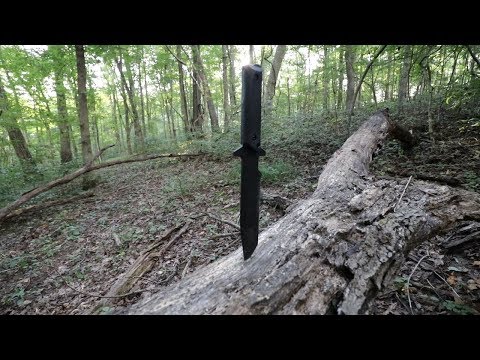
Condor Hudson Bay: Woods Cleaver! [Full Review]

Published on June 26, 2015
Duration: 14:56

This review of the Condor Hudson Bay knife, nicknamed the "Woods Cleaver," highlights its exceptional value for its price point of $45. The reviewer, nutnfancy, praises its robust 1075 steel, which proved surprisingly hard and durable during chopping and prying tests. While acknowledging its weight might make it unsuitable for ultralight bugout kits, he emphasizes its effectiveness as a heavy-duty chopping tool for bushcraft and survival tasks.

Quick Summary

The Condor Hudson Bay knife, nicknamed the "Woods Cleaver," is a highly capable survival and chopping tool valued at $45. It features durable 1075 steel that proved surprisingly hard in testing, making it excellent for heavy tasks like chopping wood and building shelters, despite its weight.

Chapters

  1. 00:01Intro & Naming
  2. 00:15The "Woods Cleaver" Concept
  3. 00:36Acquisition & Price Point
  4. 00:55Condor Hudson Bay 8 1/2"
  5. 01:03Initial Impressions & Likability
  6. 01:23Field Testing: Mountains & Desert
  7. 01:55Performance Summary
  8. 02:05Philosophy of Large Survival Knives
  9. 02:31Price Analysis: $45 Value
  10. 03:03Origin & Manufacturing
  11. 03:13Steel: 1075 Analysis
  12. 03:55Lanyard Hole Drilling Test
  13. 04:12Steel Hardness & Temper
  14. 04:50Chopping & Prying Performance
  15. 05:08Testing Protocol & Honesty
  16. 05:20Overall Performance Assessment
  17. 05:44Steel Thickness & Weight
  18. 05:49Weight & Balance: 16 oz Blade
  19. 06:06Sheath Weight & Total Carry
  20. 06:14Competitive Comparison: Scrap Yard Psycho
  21. 06:47Performance vs. Price Comparison
  22. 07:10Philosophy of Use: Woods Blade
  23. 07:15Bugout Kit Suitability (Weight Issue)
  24. 07:39Chopping Effectiveness Explained
  25. 07:51Blade Broadness & Momentum
  26. 08:02Limitations of Broad Blades
  27. 08:19Knife as a Compromise
  28. 08:23Prying Capability & Full Tang
  29. 08:31Blade Thickness: 5mm
  30. 08:36Hammered Finish Aesthetics & Function
  31. 08:46Splitting & Batoning Performance
  32. 09:01Grind Type: Flat with Convex Edge
  33. 09:08Convex Grind Critique (Sharpening)
  34. 09:30Convex Edge Durability & Edge Retention
  35. 09:37Paper Test & Edge Retention
  36. 09:54Post-Hard Use Edge Condition
  37. 10:05Edge Sharpness & Maintenance
  38. 10:12Blade Shape & Steel Quality
  39. 10:17Handle Design & Ergonomics
  40. 10:20Handle Material & Grip Enhancement
  41. 10:28Handle Lock-in & Capabilities
  42. 10:37Handle Length Wishlist
  43. 10:41Lanyard Hole Wishlist
  44. 10:44Sheath Overview
  45. 10:47Sheath Origin & Construction
  46. 10:51Sheath Modifications (Drain Hole)
  47. 10:56Sheath Color & Stitching
  48. 11:06Sheath Fit & Retention
  49. 11:09Knife Classification: Not a Fighting Knife
  50. 11:12Competitive Options Overview
  51. 11:21Affordability Comparison
  52. 11:23Competitive Option: SCC6
  53. 11:30SCC6 Size & Sheath Comparison
  54. 11:33SCC6 Steel: 1095
  55. 11:37Competitive Option: Camillus Marine Combat
  56. 11:44Camillus Edge Quality
  57. 11:50Hacking Comparison: Camillus vs. Hudson Bay
  58. 11:53Mass & Steel Expanse Comparison
  59. 11:56Camillus Sheath
  60. 12:01Competitive Option: Cold Steel Recon Tanto
  61. 12:05Recon Tanto vs. Hudson Bay Chopping
  62. 12:14Recon Tanto Sheath (Old School)
  63. 12:23Competitive Option: Becker BK7
  64. 12:31BK7 vs. Hudson Bay Chopping
  65. 12:45Competitive Option: Trailmaster
  66. 12:53Trailmaster vs. Hudson Bay Chopping
  67. 12:55Trailmaster Blade Shape & Length
  68. 13:00Trailmaster Moment Arm & Hacking
  69. 13:10Trailmaster Handle & Comfort
  70. 13:18Steel Strength Comparison: Hudson Bay vs. Trailmaster
  71. 13:33Competitive Option: Scrap Yard Psycho (Revisited)
  72. 13:40Psycho Thickness & Chopping
  73. 13:47Psycho Performance
  74. 13:49Time Check & Wrap-up
  75. 13:54Final Recommendation & Value

Frequently Asked Questions

What is the Condor Hudson Bay knife nicknamed and why?

The Condor Hudson Bay knife is nicknamed the "Woods Cleaver" due to its broad, cleaver-like blade shape, which makes it exceptionally effective for heavy chopping tasks in woodland environments.

What type of steel is used in the Condor Hudson Bay and how does it perform?

The Condor Hudson Bay features 1075 steel, which the reviewer found to be surprisingly hard and durable, resisting damage even when attempting to drill a lanyard hole with new bits.

Is the Condor Hudson Bay suitable for ultralight bugout kits?

While highly capable, the Condor Hudson Bay's substantial weight (16 oz for the blade alone) makes it less ideal for ultralight bugout kits where weight is a critical factor.

What are the main advantages of the Condor Hudson Bay's blade design?

The Condor Hudson Bay's broad blade and weight-forward design provide significant momentum for powerful chopping, making it an excellent tool for tasks like splitting wood and building shelters.

More Reviews Videos You Might Like

More from nutnfancy

View all →