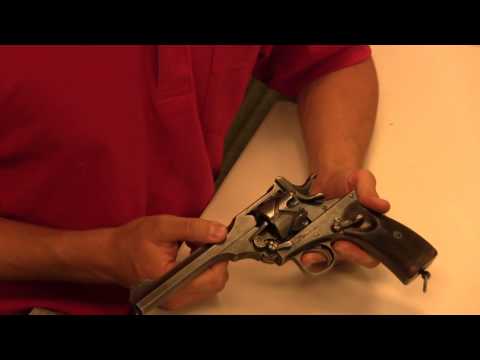
Major Fosbery's Automatic Revolver: History and Mechanics

Published on August 9, 2017
Duration: 16:20

This video provides an in-depth look at the Webley-Fosbery Automatic Revolver, a unique firearm designed by George Fosbery. It details the mechanics of its recoil-operated system, which cocks the hammer and rotates the cylinder using the energy of the fired round. The review highlights its development history, comparing it to early semi-automatic pistols and noting its eventual obsolescence despite its innovative design.

Quick Summary

The Webley-Fosbery Automatic Revolver is a unique firearm that uses recoil energy to automatically cock the hammer and rotate the cylinder. Developed by George Fosbery, its break-action design allowed for rapid ejection and reloading, but it was ultimately surpassed by more conventional semi-automatic pistols.

Chapters

  1. 00:00Introduction: Webley-Fosbery Model 1901
  2. 01:00Mechanics: How the Automatic Revolver Works
  3. 01:55Development History: Colt to Webley
  4. 03:03Webley Partnership & William Whiting
  5. 04:15Public Debut & Target Shooting Appeal
  6. 05:53Military Market & Obsolescence
  7. 07:58Technical Variations & Weight
  8. 08:47Detailed Mechanical Features
  9. 11:11Cylinder Locking & Alignment
  10. 12:30Recoil Mechanism Internals
  11. 13:32Markings and Provenance

Frequently Asked Questions

How does the Webley-Fosbery Automatic Revolver work?

The Webley-Fosbery uses the recoil from a fired shot. The upper receiver slides back, which automatically cocks the hammer and rotates the cylinder, preparing it for the next shot with a crisp single-action trigger pull.

What made the Webley-Fosbery unique compared to other revolvers of its era?

Its primary innovation was harnessing recoil to automate the cocking and cylinder rotation, a feature uncommon in revolvers. It also featured a break-action for rapid ejection and reloading, setting it apart from many contemporary designs.

Why was the Webley-Fosbery not widely adopted by the military?

Although popular with some officers, it was never officially adopted. It was quickly overshadowed by the development of more conventional and arguably more efficient semi-automatic pistols like the Colt 1911, which became the standard.

What were the main mechanical components of the Webley-Fosbery's automatic system?

Key components include the sliding upper receiver, a diamond-shaped tracking stud in the lower frame, a zigzag track on the cylinder for rotation, and an internal recoil lever with a large coil or V-spring.

More Reviews Videos You Might Like

More from Forgotten Weapons

View all →