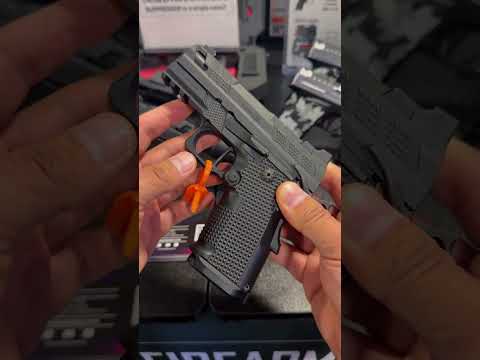
Why did Britain want this small 9mm 1911 pistol? With firearms expert Jonathan Ferguson

Published on August 2, 2023
Duration: 20:34

Jonathan Ferguson of the Royal Armouries examines a Colt Commander pistol, highlighting its design features that made it suitable for concealed carry and its consideration by British authorities in the late 1940s. Key features include a reduced barrel and slide length, an aluminum alloy frame for lighter weight, and a bobbed hammer to prevent snagging. The 9mm Parabellum caliber offered a slight capacity advantage over the .45 ACP.

Quick Summary

The Colt Commander, introduced in 1950, was designed for concealed carry with a shorter barrel and slide, an aluminum alloy frame for reduced weight, and a bobbed hammer to prevent snagging. Its 9mm variant offered a magazine capacity of eight rounds, making it an attractive option for personal defense and a subject of interest for British military trials.

Chapters

  1. 00:04Introduction to the 1911 Platform
  2. 00:46Colt Combat Commander vs. Original Commander
  3. 01:52The Colt Commander Predecessor
  4. 02:09British Connection and the Colt Commander
  5. 03:36Weight and Material Differences (Aluminum Frame)
  6. 04:49Bobbed Hammer for Concealed Carry
  7. 06:00The 9mm Parabellum Variant
  8. 07:0045 ACP vs. 9mm in the 1911
  9. 08:55British Authorities' Interest in the Commander
  10. 10:08Why Replace Existing British Pistols?
  11. 11:05The EM2 Rifle and Small Arms Strategy
  12. 12:011948 Pistol Specification Document
  13. 13:06Lightest Possible Pistol Requirement
  14. 14:12Ballistic Trials and Cartridge Options
  15. 15:34Other Pistols Under Consideration (S&W, Webley)
  16. 17:07Webley Durack and Competition
  17. 18:39Browning High Power Adoption
  18. 19:26Commander's Return as Combat Commander

Frequently Asked Questions

What made the Colt Commander suitable for concealed carry?

The Colt Commander was designed for concealed carry with a reduced barrel and slide length, an aluminum alloy frame for lighter weight, and a bobbed hammer to prevent snagging on clothing during a draw. These features made it more comfortable and practical for everyday carry compared to larger, heavier pistols.

Why was the 9mm variant of the Colt Commander considered by British authorities?

In the late 1940s, British authorities evaluated the 9mm Colt Commander as a potential new service pistol. They sought a lightweight, compact firearm that balanced ballistic performance with ease of handling, fitting into a broader strategy for modernizing their small arms.

What were the key differences between the Colt Commander and the Colt Combat Commander?

The Colt Commander was an earlier model, commercially introduced in 1950, featuring a shorter barrel and slide. The Colt Combat Commander, introduced later in the 1970s, was a further development with similar reductions in length but was often chambered in .45 ACP, while the Commander was available in 9mm.

How did the 9mm Colt Commander compare in magazine capacity to its .45 ACP counterpart?

The 9mm Colt Commander typically held eight rounds in its single-stack magazine, offering one more round than the standard seven rounds found in a .45 ACP Colt Commander or a classic 1911 pistol of similar configuration.

Related News

All News →

More Reviews Videos You Might Like

More from Royal Armouries

View all →