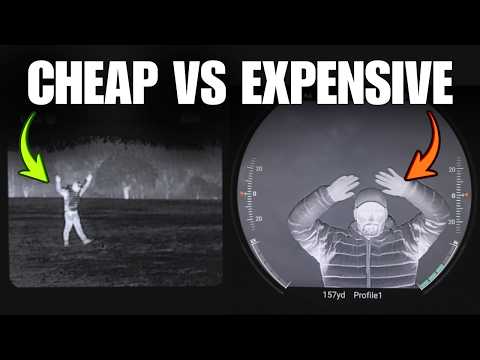
How Much Does Thermal Resolution Matter?

Published on January 12, 2025
Duration: 13:03

This video from 4MR Ranch provides an expert-level comparison of thermal optic sensor resolutions, demonstrating how higher resolutions (640 and 1280) significantly improve target identification at extended ranges (up to 2 miles) compared to lower resolutions (256 and 384). The host, with high authority, details the impact of sensor specs like pixel pitch, NETD, and resolution on practical field performance, especially in challenging daytime conditions.

Quick Summary

Higher thermal sensor resolutions (640x512, 1280x1024) significantly improve target identification at long distances (up to 2 miles) compared to lower resolutions (256x192, 384x288). Lower NETD values (<25mK) enhance sensitivity for clearer images, crucial for distinguishing targets in challenging daytime conditions where solar radiation reduces thermal contrast.

Chapters

  1. 00:00Thermal Market Trends & Resolutions
  2. 00:31ATN Optic Models Introduction
  3. 00:59Daytime Testing Environment
  4. 01:46Short Range Comparison (50-300 Yards)
  5. 05:08Mid Range Comparison (500-1000 Yards)
  6. 08:13Long Range Comparison (1.5 - 2 Miles)

Frequently Asked Questions

How does thermal sensor resolution affect target identification at long distances?

Higher thermal sensor resolutions, like 640x512 or 1280x1024, provide significantly more detail, enabling clearer identification of objects and individuals at distances up to two miles. Lower resolutions (256x192, 384x288) struggle to maintain this detail, making identification difficult or impossible at extended ranges.

What is NETD and why is it important for thermal optics?

NETD (Noise Equivalent Temperature Difference) measures a thermal camera's sensitivity. A lower NETD value, such as <25mK, means the sensor can detect smaller temperature variations, resulting in a clearer, more detailed image, which is crucial for distinguishing targets from their surroundings, especially in challenging conditions.

Does daytime testing impact thermal optic performance?

Yes, daytime testing at higher temperatures (e.g., 80°F) with moderate humidity can be a 'worst-case' scenario for thermal optics. Solar radiation reduces the thermal contrast between living objects and the environment, making higher resolution and sensitivity essential for effective performance.

Which ATN thermal optic performed best at extreme long ranges?

The ATN ThOR 5 XD, featuring the highest sensor resolution of 1280x1024 and a <25mK NETD, demonstrated the best performance at extreme distances of 1.5 to 2 miles, providing a clearly identifiable heat signature of both a vehicle and a person.

Related News

All News →

More Tactical & Gear Videos You Might Like

More from 4MR Ranch

View all →