Channel: @4mrranch
This video provides a direct comparison of thermal optics with 256, 384, and 640 core resolutions at various distances (50-500 yards) under challenging environmental conditions (high humidity, drizzle). The presenter, Kyle from 4MR Ranch, emphasizes the importance of core resolution for target identification at range, especially in adverse weather. The content is geared towards individuals looking to understand the practical differences in thermal imaging performance for tactical or observational purposes.
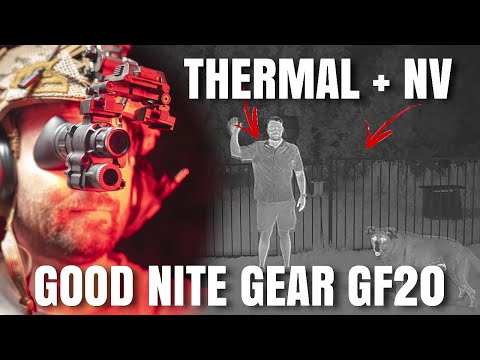
This video reviews the Good Nite Gear GF20, a thermal fusion monocular combining digital night vision and thermal imaging. The reviewer highlights its effectiveness for hog hunting, noting its ability to detect targets thermal alone might miss and identify them with night vision. Key features include adjustable fusion modes, a built-in IR illuminator, and a remote battery pack. The device offers a significant advantage in low-light conditions by providing both detection and identification capabilities.
This video compares budget-friendly analog night vision (Cold Harbor Supply PVS-14 with ~1600 FOM, 24 SNR) against a premium unit (Warhammer Armaments PVS-14 with ~2700 FOM, 36 SNR) across various lighting conditions. The instructor, Kyle from 4MR Ranch, highlights that while the higher FOM and SNR provide more detail and less noise, the perceived difference may not always justify the significant price gap for many users, especially in environments with ambient light. The video also touches on the utility of IR illuminators and adjustable irises.
This review of the AGM Rattler V3 LRF 35-640 thermal optic highlights its features, performance, and reliability. The reviewer, Kyle from Four Mile Ranch, details the optic's V3 generation, integrated LRF, 35mm objective lens, 640 core, and sub-15mK sensitivity. He demonstrates its ease of zeroing, the effectiveness of its onboard ballistic calculator, and its user-friendly interface. The review also touches on its durability over four months of use and its compatibility with Apple computers for firmware updates.
This guide details how a novice shooter successfully engaged targets at 1,000 yards with a Barrett MRAD rifle. It emphasizes the importance of proper setup, including using a booster seat for stability and familiarizing the shooter with scope adjustments. The process covers aiming, firing, cycling the bolt, and making ballistic corrections for long-range accuracy, demonstrating that even beginners can achieve hits with the right approach and equipment.
This video provides an in-depth review of the Invisible Sight Mark 5 NGAL clone, comparing it to other clones and the genuine L3Harris NGAL. The reviewer, Kyle from 4MR Ranch, highlights its reliability and performance, particularly its durability under recoil from a SCAR 17 and various other platforms. He details its alignment, illumination performance, and compares it to the Big PEX clone, concluding it's a top-tier NGAL clone for those seeking an alternative to L3Harris prices.
This video provides a comprehensive review of the Infiray IOP 13 and IOL 25 thermal optics, comparing their features, performance, and price points. The presenter, Kyle from FormerRanch, details the technical specifications, including sensor resolutions and base magnifications, and discusses their utility for various applications like hog hunting and low-light observation. The review also covers advanced features such as clip-on mode, integration with digital night vision devices like the DNVS 14 Pro, and the overall build quality and reliability of the optics.
This video provides a detailed comparison of thermal optics with 256, 384, and 640 core resolutions. It demonstrates how higher core resolution significantly improves target identification at various distances, particularly for distinguishing animals like deer from other potential targets. The comparison also highlights the impact of resolution on the zeroing process, with higher resolutions making it easier to see impacts on paper targets.
The Laser Speed M6T ARV Gen 2 features an edge-emitting laser illuminator and an integrated white light head. Key improvements over previous generations include enhanced switchology with fins for better tactile indexing, especially in the dark, and added fins to convergence/divergence controls. It now includes an in-house diffuser for a low-profile, secure fit, making it a functional four-in-one device with visible, IR, and white light override functions.
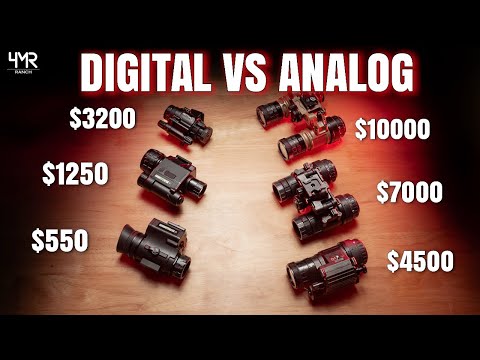
This video provides a detailed comparison between digital and analog night vision devices across various price points and performance levels. The presenter, Kyle from Four Mile Ranch, evaluates budget, mid-range, and high-end options for both digital and analog technologies, demonstrating their capabilities in different lighting conditions, including full moon and complete darkness. Key factors like refresh rate, image clarity, resolution, and the effectiveness of IR illumination are discussed, offering insights into the current state and future potential of digital night vision compared to traditional analog systems.
This video provides an expert-level review of the Holosun IRIS GR4 laser aiming device, highlighting its value proposition for the price point. The instructor, Kyle from 4MR Ranch, emphasizes its reliability, compact form factor, and multi-functionality, including IR illuminator, IR laser, visible laser, and a strong white light. He details its performance on a SCAR 17 and discusses its suitability for duty use, recommending it as a top-tier option for self-funded law enforcement officers.
This video reviews the new Infitac IOP 13 thermal optic, comparing it to the Infitac IOL 25. It highlights the IOP 13's 256 core sensor and 1.5x base magnification, contrasting it with the IOL 25's 384 core sensor and 2x magnification. A key feature discussed is the 'IoT configuration,' allowing thermal imaging to be transmitted to a monocular, useful for tactical applications or as a hunting guide to monitor guests' targets.