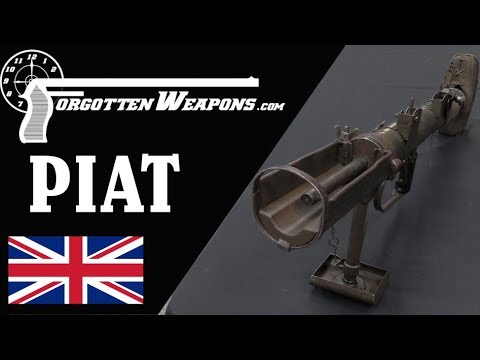
WW2 Anti-Tank Weapn: British PIAT

Published on July 5, 2024
Duration: 7:28

This video details the British PIAT (Projectile Infantry Anti-Tank) weapon from World War II. It explains the PIAT's development as a replacement for the Boys Anti-Tank Rifle, its unique mortar-like round with a shaped charge, and its operational mechanics. The presenter demonstrates the loading and firing process, highlighting its effectiveness against armor up to 3-4 inches and its dual role as an anti-tank weapon and a mortar for indirect fire up to 300 yards.

Quick Summary

The British PIAT (Projectile Infantry Anti-Tank) was a World War II weapon designed to defeat tanks. Its unique mortar-like round featured a shaped charge for penetrating 3-4 inches of armor, with effective ranges up to 100 yards against tanks and 300 yards for indirect fire. A key feature was its automatic recoil reset, enabling faster follow-up shots compared to other anti-tank weapons.

Chapters

  1. 00:00Introduction to the PIAT
  2. 00:13What is the PIAT?
  3. 00:31Replacement for the Boys Anti-Tank Rifle
  4. 00:58PIAT's Shaped Charge Round
  5. 01:19Effective Range and Accuracy
  6. 01:42German Defenses Against PIAT
  7. 02:19Close-up of the Shaped Charge and Firing Pin
  8. 02:43Deactivated PIAT Mechanism
  9. 03:15Monopod and Initial Recognition
  10. 03:25PIAT in War Movies
  11. 03:39Close-Range Effectiveness and Nerves of Steel
  12. 03:50PIAT vs. Bazooka: Recoil and Reloading
  13. 04:17Extended Range and Mortar Use
  14. 04:40Trigger and Safety Mechanism
  15. 05:03Firing the PIAT
  16. 05:51Recoil and Force of the Weapon
  17. 06:07Theory on Propellant Force
  18. 06:30Propellant vs. Thrust Mechanism
  19. 06:43PIAT in Media and 'A Bridge Too Far'
  20. 07:05Conclusion and Channel Plug

Frequently Asked Questions

What was the primary purpose of the British PIAT anti-tank weapon?

The PIAT (Projectile Infantry Anti-Tank) was developed by the British during World War II to provide infantry with a portable weapon capable of defeating enemy tanks, replacing the less effective Boys Anti-Tank Rifle.

How did the PIAT's projectile work against tank armor?

The PIAT utilized a unique round described as a mortar-like projectile containing a shaped charge. Upon impact, this charge focused its explosive energy to penetrate or melt through tank armor up to 3 to 4 inches thick.

What were the effective ranges of the PIAT?

Against tanks, the PIAT was most effective at close ranges, typically up to 100 yards, though some sources suggest 75-110 yards. It could also be used as a mortar for indirect fire up to 300 yards.
What made the PIAT's operation unique compared to other anti-tank weapons like the Bazooka?

A key advantage of the PIAT was its automatic recoil reset. After firing, an internal spring mechanism would return the launcher to a ready-to-fire position, allowing for faster follow-up shots than weapons like the Bazooka which required manual reloading.

More Tactical & Gear Videos You Might Like

More from Legacy Collectibles

View all →