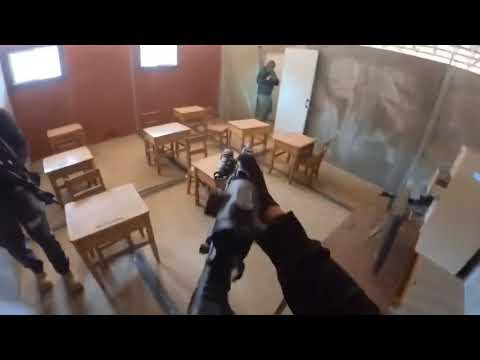
CQB Actions Upon Entry: Stepping Center

Published on April 10, 2025
Duration: 5:13

This video details the 'Stepping Center' technique for Close Quarters Battle (CQB) entry, emphasizing coordinated team movement and communication. Instructors David Harris and Matt Kish of Tactical Hive explain how to establish attack angles, use non-verbal cues for entry initiation, and execute a fluid step into the room while maintaining team security. The technique focuses on maximizing observation, minimizing exposure, and ensuring seamless team integration during initial entry.


Quick Summary

The 'Stepping Center' is a CQB entry technique where the primary breacher ('one man') takes a fluid step into the center of the doorway after receiving a readiness signal from their partner ('two man'). This move is designed for immediate threat engagement, not further observation. Communication is kept simple, often using non-verbal cues or basic calls like 'open door front' to maintain stealth.

Chapters

  1. 00:18Introduction & Topic
  2. 00:30CQB Entry Steps: Diminishing Returns & Cover
  3. 00:47Understanding Attack Angles
  4. 01:11Determining Entry Order: Calling Threats
  5. 01:35Importance of Non-Verbal Communication
  6. 02:13Example: Calling 'Open Door Front'
  7. 02:24Two Man's Readiness Signal
  8. 02:33Executing the 'Step Center'
  9. 03:09Two Man's Role: Covering Critical Corner
  10. 04:44Full Speed Demonstration
  11. 04:54Outro & Call to Action

Frequently Asked Questions

What is the 'Stepping Center' technique in CQB?

The 'Stepping Center' is a CQB entry technique where the primary breacher ('one man') takes a fluid step into the center of the doorway after receiving a readiness signal from their partner ('two man'). This move is designed for immediate threat engagement, not further observation.

How do CQB teams communicate entry priorities?

CQB teams prioritize simple, non-verbal communication. The 'one man' calls out observed threats like 'open door front' or 'open door left'. Silence indicates no immediate threats, and the 'two man' uses visual cues like a barrel dip or raise to signal readiness.

What is the role of the 'two man' during CQB entry?

The 'two man' provides crucial support. They signal readiness to the 'one man' and, once entry begins, immediately move behind the 'one man' to cover the 'critical corner' on their side, ensuring the team's backside is secure.

Why is 'speaking in crayon' important in CQB?

'Speaking in crayon' refers to using extremely simple, basic language for communication in CQB. This reduces confusion, minimizes noise, and prevents the enemy from easily locating the team, enhancing operational security and effectiveness.

More Training & Techniques Videos You Might Like

More from Tactical Hyve

View all →