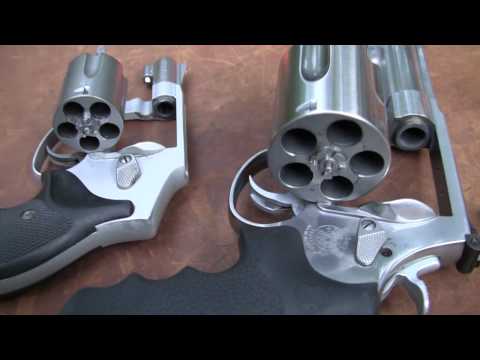
Revolvers: Colt vs Smith & Wesson

Published on May 23, 2011
Duration: 25:29

This guide details the operational differences between Colt and Smith & Wesson revolvers, focusing on their distinct cylinder latch mechanisms and rotation directions. Hickok45, a recognized firearms expert, explains how these mechanical variations impact ergonomics and tactical reloading. Understanding these nuances is crucial for proficient revolver handling.

Quick Summary

Hickok45, a seasoned firearms expert, compares Colt and Smith & Wesson revolvers, highlighting key mechanical differences like cylinder latch operation (pull vs. push) and rotation direction (clockwise vs. counter-clockwise). He explains the ergonomic and tactical implications of these designs, particularly for reloading, and discusses the benefits of features like bull barrels for recoil management.

Chapters

  1. 00:00Introduction: Colt vs. S&W Royalty
  2. 01:14Initial Shooting Demonstration
  3. 02:03Double-Action Mechanics Explained
  4. 03:45Cylinder Latch Differences: Push vs. Pull
  5. 04:40Cylinder Rotation Direction Impact
  6. 07:45Model Comparisons and Frame Sizes
  7. 08:46Vintage Colt New Service Deep Dive
  8. 11:12S&W Model 13 and Bull Barrels
  9. 13:16Rapid Fire and Versatility

Frequently Asked Questions

What is the main functional difference between Colt and Smith & Wesson revolver cylinder latches?

Colt revolvers feature a cylinder latch that must be pulled backward to release the cylinder, while Smith & Wesson revolvers utilize a latch that is pushed forward. The S&W design is often considered more ergonomic and intuitive for operation during shooting or reloading.

Why is the cylinder rotation direction important in revolvers?

The direction of cylinder rotation (clockwise for Colt, counter-clockwise for S&W) is crucial for tactical reloading. Understanding this allows a shooter to ensure that live rounds are correctly positioned to be fired after partially loading the cylinder, optimizing efficiency under pressure.

What is the advantage of a bull barrel on a revolver like the S&W Model 13?

A bull barrel is significantly heavier than a standard barrel. This added mass helps to absorb recoil, making it more comfortable to shoot full-power .357 Magnum ammunition and potentially improving accuracy by reducing muzzle flip.

What can cause light primer strikes in a double-action revolver?

Light primer strikes can occur if the mainspring has been intentionally weakened to create a smoother, lighter trigger pull in double-action mode. If weakened too much, the hammer may not strike the primer with sufficient force to ignite the cartridge.

Related News

All News →

More Training & Techniques Videos You Might Like

More from hickok45

View all →