This video features Hickok45 demonstrating the unique operation of the Freedom Arms Model 83 revolver. He highlights the necessity of the hammer being at half-cock for cylinder rotation, a key difference from other single-action designs. The session also includes a practical comparison of .45 Colt and .454 Casull ammunition, showcasing their performance and recoil characteristics.
This video provides an in-depth mechanical breakdown of the Pieper Revolving Carbine, focusing on its unique gas-operated system and stretched-out rifle configuration. It details the single and double-action lockwork, explaining how the hammer, trigger, and various arms interact to cycle the action, lock the cylinder, and ensure proper sealing. The explanation highlights the system's complexity compared to simpler designs while illustrating its functional mechanics.
This video provides an in-depth look at the Webley Fosbery, specifically a Model 1901. It highlights the unique recoil-operated mechanism that rotates the cylinder and recocks the hammer after each shot, allowing for repeated single-action firing without manual cocking. The presenter notes the gun's historical context, its innovative design attempting to blend revolver and semi-automatic features, and its reputation for being delicate and not well-liked at the time of its production, despite being a valuable collector's item today.
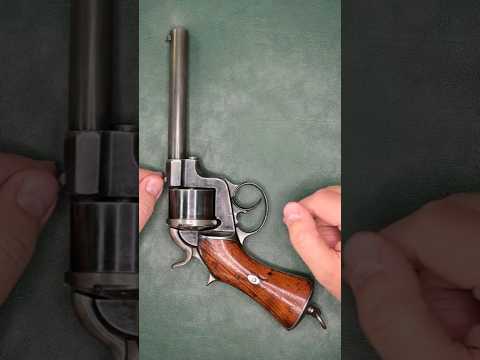
This video details the Pidault-Cordier "Raphael" revolver from 1860, highlighting its advanced features for its time, including a center-fire system with a unique brass casing that could cause cylinder rotation issues. It explains the specific loading and unloading procedure involving a safety position and a gate mechanism, and touches upon its historical procurement by the US Army during the Civil War.
The Adams Mark III revolver, weighing 2.33 lb with an 11-inch overall length, is a refined version of its predecessor. Key improvements include a more tactile and faster counter-rotating cylinder for loading and a pair-like ejector rod setup that nests within the arbor at rest. The action remains undemanding with light hammer and trigger pulls.
This YouTube video, titled 'Cylinder Rotation', focuses on firearms. The description provides initial clues with hashtags like #edc, #colt, and #ruger, suggesting a content related to everyday carry, Colt firearms, and Ruger firearms. The title itself, 'Cylinder Rotation', directly implies a focus on the operation of revolvers, a specific type of firearm. This suggests the video likely covers the mechanical function or handling of revolvers, potentially in the context of their use for concealed carry or general firearm operation.
This guide, presented by Johnny Q, demonstrates how to check if a revolver's cylinder is functioning correctly. It highlights the importance of removing safety devices like plugs before operation and discusses the debate around the proper method for closing a revolver cylinder – gently or with a snap. The video emphasizes safe firearm handling throughout.
This guide details the manual cycling process for the Puckle Gun, a 1718 repeating firearm. It emphasizes the importance of safety and the step-by-step procedure for rotating the nine-round cylinder to prepare for subsequent shots. The information is presented with the authority of Ian McCollum, known for his expertise in historical firearms.
This follow-up video addresses previous cylinder rotation issues with a Colt Anaconda 4-inch revolver, which appear to have resolved themselves. The presenter tests various .44 Magnum loads, including stout H110 rounds and lighter 'powder puff' loads, noting the performance differences and potential primer issues with Winchester primers versus CCI. The video emphasizes the importance of unedited footage to showcase the firearm's performance and discusses the satisfaction of shooting powerful revolvers.
This guide, based on instruction from firearms expert JaredAF, details how to determine a revolver's cylinder rotation direction by examining the cylinder stop notches. It highlights the distinct ramp orientations used by manufacturers like Smith & Wesson and Colt to indicate their respective rotation directions. This technique is crucial for understanding revolver mechanics.
This guide details the internal workings of a Smith & Wesson Model 25 revolver, as explained by an expert instructor. It covers the DA/SA action, cylinder rotation mechanism, and the firing sequence, emphasizing the use of forged internal parts in this specific model. The explanation is technical and demonstrates a deep understanding of revolver mechanics.
This guide details the operational differences between Colt and Smith & Wesson swing-out cylinder revolvers, as explained by firearms enthusiast JaredAF. Key distinctions include the direction of cylinder release (push forward for S&W, pull back for Colt) and the direction of cylinder rotation (counter-clockwise for S&W, clockwise for Colt). Understanding these differences is crucial for proper loading and operation, especially when carrying a reduced number of rounds.
Gun Laws by State
Read firearms regulations for all 50 states + D.C.
Find Gun Dealers
Search licensed FFL dealers near you.