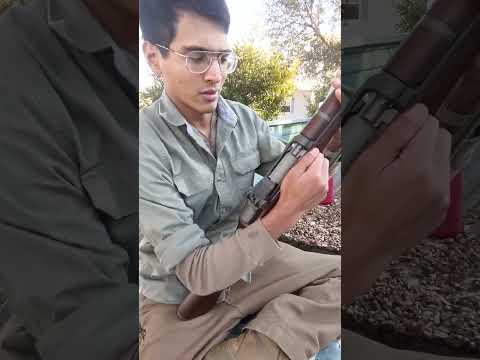
Slow Motion: M1 Garand

Published on October 22, 2014
Duration: 1:40

This video provides an expert-level, high-speed (2000 frames per second) look at the M1 Garand's firing cycle and distinctive en-bloc clip ejection. The explanation details the interaction of the op-rod, bolt, and locking lugs, offering a clear, step-by-step understanding of the rifle's operation. It highlights the unique visual of the clip ejecting after the last round is fired.

Quick Summary

The M1 Garand's firing cycle, captured in 2000fps high-speed slow motion, reveals the intricate interplay between the operating rod (op-rod) and the bolt. After firing, the op-rod moves rearward, unlocking the bolt and extracting the spent casing. The bolt then retracts, ejects the case, and chambers the next round before locking into place. A distinctive feature is the en-bloc clip's automatic ejection from the top of the receiver after the last round.

Chapters

  1. 00:00Introduction: M1 Garand High-Speed
  2. 00:05Side View Firing Action
  3. 00:11Angled View Firing Mechanics
  4. 00:25High-Speed Clip Ejection
  5. 00:31Slow Motion Firing Cycle Breakdown
  6. 00:39Bolt Unlocking and Retraction
  7. 00:49Ejection and Next Round Feed
  8. 00:56Chambering and Locking
  9. 01:10Complete Firing Cycle & Clip Ejection Recap
  10. 01:18Detailed Clip Oscillation
  11. 01:25Conclusion and Channel Plug

Frequently Asked Questions

What is the primary function of the operating rod (op-rod) in the M1 Garand's firing cycle?

The operating rod (op-rod) in the M1 Garand is crucial for cycling the action. After firing, it moves rearward to engage the bolt lug, facilitating bolt unlocking and retraction, which extracts the spent casing and prepares the rifle to chamber a new round.

How does the M1 Garand's clip ejection differ from other semi-automatic rifles?

The M1 Garand is unique in its use of an en-bloc clip that is inserted into the receiver and automatically ejected from the top once the last round is fired. This 'ping' sound and visual ejection are iconic features of the M1 Garand.

What is the significance of high-speed photography in analyzing firearm mechanics like the M1 Garand?

High-speed photography, such as the 2000 frames per second used here, allows for the detailed observation of extremely rapid mechanical movements within a firearm during operation. This reveals intricate interactions between components like the op-rod, bolt, and locking lugs that are imperceptible at normal speeds.

What are the key stages of the M1 Garand's firing cycle?

The M1 Garand's firing cycle involves: firing, op-rod rearward movement to engage bolt lug, bolt unlocking and retraction, extraction of spent case, ejection of spent case, presentation of next round, bolt forward movement to chamber new round, and finally, bolt locking via lug rotation.

More Training & Techniques Videos You Might Like

More from Forgotten Weapons

View all →