Channel: @inertordnance
This video documents a test firing of a 50mm prototype mortar round. The test highlights the significant impact of wind on projectile trajectory and stability, causing the round to tumble and land prematurely. The discussion focuses on the round's failure to maintain stability and its reduced range due to adverse wind conditions, suggesting adjustments to firing parameters might be necessary for future tests.
This guide details the process of bore sighting the 90mm M67 Recoilless Rifle, a critical step for ensuring accurate first-round hits. It covers selecting an aiming point, using specialized equipment like strings and a boresight disc to align the bore axis, and then aligning the telescope sight to match the bore's trajectory. Proper bore sighting is essential for maximizing the weapon's effectiveness.
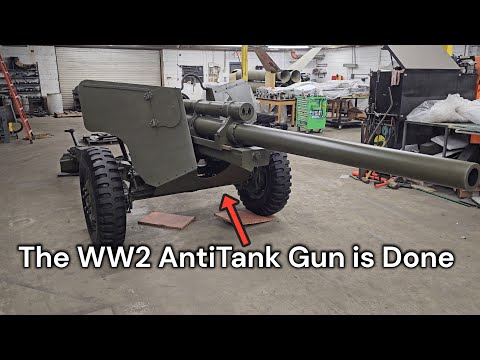
This video documents the final stages of restoring a 3-in M5 anti-tank gun by Dylan from Mortarinus.com. The project, which took approximately 60 days, involved touch-up work and final detailing. The restored gun is being shipped to the National Museum of Military Vehicles. The channel has also begun a new project: the restoration of a Nike Hercules missile system.
This video explains the mechanics of an Armor-Piercing Fin-Stabilized Discarding Sabot (APFSDS) round, commonly used in tanks like the M1 Abrams and M60 Patton. It highlights that these rounds utilize kinetic energy, not explosives, to penetrate targets. The core component is a dense rod, often made of depleted uranium, which travels at extreme velocities.
This video details the initial disassembly phase of restoring a 76.2mm M5 anti-tank gun and its M6 carriage. Key steps include removing seized pins from the carriage legs using heat and force, cleaning all components, and disassembling wheel hubs and bearings. The process emphasizes meticulous labeling of parts for the subsequent restoration stages.
This video details the multi-week restoration and reassembly of a 3-inch M5 anti-tank gun. The process involves extensive cleaning, blasting, bodywork, welding, priming, and painting of various carriage components, including the axle, legs, hubs, brakes, and shield. The final stages focus on bottom-up reassembly, installation of functional parts like the traverse mechanism, and the mounting of the gun and its dummy breach. The project is nearing completion for museum display.
This video provides a shop update detailing the ongoing restoration of an M5 anti-tank gun and its M6 carriage. The presenter, Dylan from mornings.com, shows the disassembled components and outlines the plan to document the restoration process step-by-step. The focus is on the mechanical restoration of the gun and carriage.
The M202A1 is a 66mm rocket launcher capable of firing four incendiary rockets in rapid succession. It is designed for attacking hardened targets like bunkers and automatic weapon positions, as well as for material destruction. With a 200-yard range for point targets, it offers a significant advantage over traditional flamethrowers.
This demonstration showcases the capabilities of the Hotchkiss Mle 1934 25mm Anti-Tank Gun. The video details its transport, setup, loading, firing, and the resulting penetration of a 1-inch steel plate, highlighting its anti-armor potential.
This guide details the assembly and armament of the 5"/127mm ZUNI rocket system, as demonstrated in a workshop and combat context. It covers rocket preparation, launcher safety, firing mode selection, and loading procedures. The video highlights expert handling of military ordnance, including a cutaway view of the rocket's internal components and its deployment from Mi-24 Hind helicopters.
This video provides an expert-level guide to assembling various 2.75-inch FFAR (Forward Firing Aerial Rocket) variants, including HE HBX-1, HEAT COMP-B, and HE COMP B4 warheads. The demonstration covers the modular nature of these rockets, showing how different warheads attach to standard rocket motors and are then loaded into launch tubes. Archival footage illustrates their use on platforms like the AH-64 Apache.
This video provides an in-depth tour of the Ordnance.com restoration shop, detailing the comprehensive process of bringing antique and military firearms and components back to life. It covers essential stages from initial disassembly and abrasive blasting to bodywork, painting, polishing, and final assembly. The shop utilizes specialized equipment like sandblasting cabinets, CNC water jets, and a paint booth, emphasizing meticulous attention to detail for museum-quality results.