This video from Warrior Poet Society explains how temperature significantly impacts long-range rifle accuracy. Instructor John Lovell details two primary mechanisms: changes in air density, which affect bullet flight, and alterations to the powder's burn rate, influencing projectile velocity and energy. Understanding these variables is crucial for consistent performance at extended distances.
This video details a muzzleloader elk hunt in New Mexico and provides technical instruction on understanding and compensating for air density in long-range shooting. It also includes a DIY guide for installing a scope leveling device to prevent rifle cant. The content is presented by experienced individuals from Gunwerks, offering practical advice for hunters and shooters.
This video follows an elk hunt in Wyoming, showcasing long-range shooting techniques and ballistics considerations. It highlights the importance of understanding environmental factors like wind, altitude, and temperature for accurate long-range shots. The content emphasizes practical application in a hunting scenario, demonstrating how to adjust for these variables to achieve success in the field.
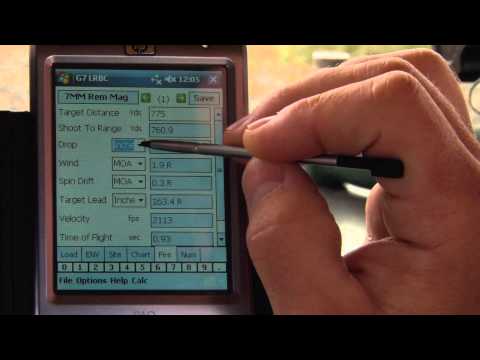
This episode of Long Range Pursuit follows a sheep hunt in Montana and a mule deer hunt in Utah, showcasing long-range shooting techniques and the importance of understanding external ballistics. The hosts demonstrate how to use ballistic calculators, specifically the G7 calculator, to account for windage and trajectory at extended distances. The content emphasizes practical application in hunting scenarios, highlighting the need for accurate data input and compensation for environmental factors to achieve successful shots.
This video from InRangeTV investigates the impact of ammunition and ambient temperature on rifle zero. While extreme temperature variations were tested, the experiment concluded that for this specific ammunition (Hornady 6.5 Creedmoor 140 grain) and rifle, the temperature of the ammunition itself had a negligible effect on point of impact. However, a significant shift in point of impact was observed due to changes in ambient temperature, demonstrating its greater influence on ballistics.
This expert-level guide from Gunwerks demonstrates the critical impact of environmental variables like altitude, temperature, and shot angle on long-range windage hold. It highlights the inadequacy of fixed turrets and showcases how advanced ballistic rangefinders provide the exact corrections needed for consistent accuracy. The instruction emphasizes the necessity of precise windage calculations for extended distances.
This video from the Gunwerks YouTube channel provides a shooting tip focused on understanding and accounting for air density. The description highlights that the channel offers more content on long shots, tough shots, shooting tips, DIY projects, and ballistics. This suggests the video aims to educate viewers on factors affecting long-range shooting accuracy.
This video from Long Range University explains the critical inputs for air density in ballistics programs, focusing on station pressure, temperature, and humidity. It details how to use measured station pressure or equivalent altitude to achieve accurate ballistic solutions, emphasizing the importance of real-world environmental data for precise long-range shooting.
This guide details essential techniques for long-range mountain shooting, emphasizing the critical impact of incline and air density on projectile trajectory. It highlights how to compensate for these factors using tools like the G7 BR2 Rangefinder and ballistic calculators, as explained by Aaron Davidson, owner of Gunwerks.
This video explains how to compensate for air density when using BDC turrets or reticles. It details how air temperature and pressure affect bullet trajectory and introduces tools like the G7 Rangefinder and handheld devices for atmospheric measurement. A rule of thumb is provided for making click corrections based on elevation and temperature changes.
This video explains how to use the 'Fire Solution' feature on the G7 Ballistic Calculator. It details how to input environmental factors like air density and incline to calculate a 'shoot-to' range, which adjusts for ballistic turrets or reticle holds. The output also includes drop, wind deflection, spin drift, target lead, time of flight, bullet energy, and velocity.
You've reached the end! 11 videos loaded.
Gun Laws by State
Read firearms regulations for all 50 states + D.C.
Find Gun Dealers
Search licensed FFL dealers near you.