This review of the Lignose 'Einhand' pistol highlights its innovative one-handed operation, designed for soldiers with hand injuries. The presenter, James Reeves from TFBTV, demonstrates its unique slide racking mechanism, bottom-fed magazine, and surprisingly soft shooting characteristics despite its small .25 ACP caliber. The pistol's historical context, originating from the Bergmann design around 1910 and produced by Lignose after 1928, is also discussed, emphasizing its practicality for concealed carry.
This video focuses on the conservation, cleaning, oiling, and inspection of a Bergmann 1910/21 pistol chambered in 9x23 Largo. While explicitly stating it's not a tutorial, the content aims to guide viewers on what they need to know to perform these tasks themselves, emphasizing the need for expertise. The description also includes a link for viewer support via Patreon and a reference to another video, "Primer 140."
This video details the 'System Schmeisser' upgrade for the WWI-era MP-18 submachine gun, focusing on the transition from the awkward snail drum magazine to a more reliable 20-round box magazine. It highlights Hugo Schmeisser's role, the post-Versailles Treaty context for German police firearms, and the technical rationale behind the single-stack magazine design. The upgrade significantly influenced later submachine gun designs like the MP-38 and MP-40.
This WWI Primer episode from C&Rsenal delves into the history, function, and live-fire demonstration of the Danish Bergmann 1910 pistol. Hosted by Othais and Mae, the documentary explores this WWI firearm as part of the centennial anniversary series. The video also provides links to support the channel, purchase merchandise, and references additional reading material and related content, including other Bergmann pistol reviews.
This review examines a unique Bergmann M1910 prototype pistol, highlighting its distinct angled grip and target sights compared to standard models. The pistol's serial number places it within the Danish contract range, yet its features suggest factory experimentation or a custom build, presenting a historical puzzle. The analysis emphasizes how such prototypes reveal the evolution of firearm design and user-specific modifications.
This video details the complex restoration of a deactivated Bergmann MP-18 submachine gun. Mark Novak showcases advanced gunsmithing techniques, including custom tooling and precision lathe work, to overcome significant damage caused by deactivation welds. The process involves carefully removing internal welds, manufacturing replacement parts, and test firing the functional firearm.
This episode of American Rifleman TV features a preview of segments on British 1st Airborne operations during WWII, specifically focusing on Operation Market Garden and their efforts at Arnhem. The "Rifleman Review" segment will examine the Marlin Model 1894 chambered in .44 Magnum. Additionally, the "I Have This Old Gun" feature will explore the history and development of the Bergmann MP-28 submachine gun, a firearm designed between the World Wars. The video also provides information on where to find full episodes of ARTV online and tune in for new episodes on the Outdoor Channel.
This video is a book review of "Vom Ursprung der Selbstladepistole" (Origins of the Automatic Pistol) by Josef Mötz and Joschi Schuy. The book, written in German, focuses on early manually operated and self-loading pistols from Austro-Hungarian designs. It covers a wide range of manufacturers, from well-known names like Mannlicher and Bergmann to lesser-known ones. The reviewer emphasizes the book's historical information, photographs, and patent details, recommending it as an indispensable resource for anyone interested in early handguns. The description also provides links to purchase the book from Amazon and the publisher directly, as well as a Patreon link.
The Bergmann MP35, though a WWII-era submachine gun, was not adopted by the Wehrmacht but primarily by the SS and police. It features a distinctive right-side magazine feed, a progressive trigger for semi-auto and full-auto fire, and a unique bolt-action-style cocking handle for a sealed receiver. Despite its complex design, it offered a manageable rate of fire and internal safety features.
This review covers the two-volume book set 'Deadly Beauties: Rare German Handguns' by Hermann Hampe and Jean Varret. Published by Schiffer Publishing, these books serve as high-quality photographic references for collectors, focusing on rare German sidearms from 1871 to 1945. Ian McCollum highlights their value for authenticating scarce firearms.
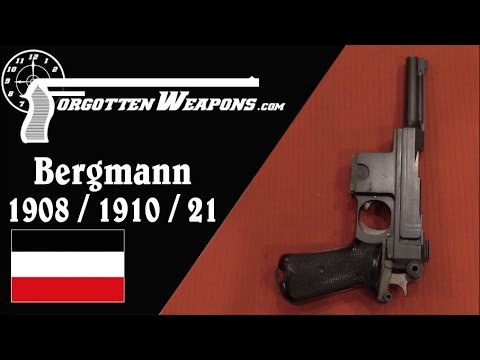
This review details the Bergmann-Bayard pistols, specifically the 1908, 1910, and 1910/21 models. It covers their Spanish and Danish military adoptions, production by AEP in Belgium, and Danish domestic manufacturing. Key mechanical evolutions and unique features like reversible shoulder stock/holsters are highlighted.
This video showcases a collection of finely engraved Bergmann pistols, highlighting their historical significance and artistic craftsmanship. Featured models include two 1896 No. 3s, a Bergmann Mars 1903, and a 1910. The video emphasizes the distinct banknote-style scrollwork with gold accents, characteristic of Bergmann factory engraving, and also points out a unique 1910 with external engraving and an Arabic inscription. The 1896 model is presented in its original presentation case, offering a glimpse into the quality of Bergmann firearms from the late 19th century.
Gun Laws by State
Read firearms regulations for all 50 states + D.C.
Find Gun Dealers
Search licensed FFL dealers near you.