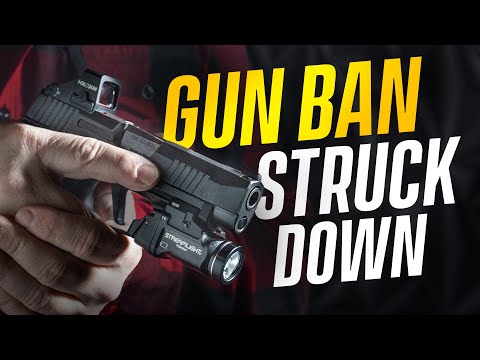
This video discusses the importance of the Bruen analysis when legislatures consider new firearms laws. It emphasizes that lawmakers should proactively assess whether proposed legislation can withstand legal scrutiny under the Bruen standard, rather than waiting for court challenges. The discussion also touches on how the categorization of certain items, like marijuana, is a key point of inquiry in legal arguments.
This video from CRPA TV features an expert discussion on the legal arguments surrounding gun control, specifically how historical laws like the Black Codes are being used in Second Amendment litigation. The speaker, affiliated with Second Amendment advocacy groups, critically analyzes the relevance of the Black Codes in modern Bruen analysis, highlighting their discriminatory purpose of disarming freed slaves. The discussion references Supreme Court Justice Ketanji Brown Jackson's stance on unconstitutional laws.
Reno May discusses the Baird v. Bonta lawsuit challenging California's open carry restrictions. A ruling found parts of the ban unconstitutional, but the 9th Circuit Court is expected to intervene, likely staying the decision. The current status quo for open carry in California remains largely unchanged for the general public.
This video discusses the critical Supreme Court case Range v. Garland, which challenges federal laws prohibiting individuals with non-violent felony or misdemeanor convictions from owning firearms. It analyzes how the Bruen analysis might be applied and highlights the case's potential impact on Second Amendment jurisprudence, especially in relation to non-violent offenses. The discussion also touches upon the related US v. Raheem case concerning domestic violence restraining orders and President Biden's recent executive actions on gun control.
A lawsuit has been filed by several Second Amendment organizations, including the NRA, challenging Colorado's new 6.5% excise tax on firearm and ammunition purchases. The legal challenge argues the tax is unconstitutional, citing historical precedent and Supreme Court rulings that prohibit targeted taxes on constitutional rights. The plaintiffs contend that such taxes hinder the exercise of the right to keep and bear arms and that Colorado cannot demonstrate a historical tradition of such taxation.
This video analyzes the US Court of Appeals for the Third Circuit's ruling in Lore v. Pennsylvania, which affirmed Second Amendment rights for 18-20 year olds. It highlights how the Supreme Court's "law trapped in amber" language from the Rahimi case is being misinterpreted by anti-gun groups. The speaker argues this phrase actually supports the expansion of Second Amendment protections to modern arms and individuals, not just historical regulations.
This video analyzes the Third Circuit's decision in USA v. Range, which struck down a ban on firearm possession for nonviolent felons. It explains the legal arguments, including the Bruen analysis and the concept of 'the people' in the Second Amendment. The decision creates a circuit split, likely leading to a Supreme Court review.
A federal district court in USA v. Morgan dismissed machine gun possession charges, ruling that restrictions violate the Second Amendment under the Bruin analysis. The court found the government failed to provide sufficient historical evidence to justify the ban on firearms like machine guns and Glock switches. This decision is now under appeal at the 10th Circuit Court of Appeals, with briefs due in November 2024.
This video provides an expert analysis of the Ninth Circuit's decision on California's SB2 concealed carry ban. The speaker, demonstrating deep legal expertise, breaks down which provisions were struck down and which were upheld, referencing the Bruen analysis and historical legal precedents. The discussion highlights the mixed nature of the ruling and the ongoing legal challenges, including appeals to en banc panels and potential Supreme Court review.
This video details the significant ruling in Schoenthal v. Raoul, where a federal court struck down Illinois' ban on carrying concealed firearms on public transportation (CTA and Metra) as unconstitutional. The court found that Illinois failed to demonstrate a historical tradition of firearm regulation justifying the ban, granting summary judgment to the plaintiffs. The ruling, an 'as applied' challenge, declared the ban a violation of the Second Amendment in its application to the named plaintiffs, though it may face appeal.
This video provides an expert analysis of the 'Nguyen v Bonta' case challenging California's 1-in-30 firearms purchase law before the 9th Circuit Court of Appeals. The discussion, led by an experienced commentator familiar with firearms law, delves into the legal arguments concerning the Second Amendment, the historical context required by the Bruen decision, and the state's justifications for the delay. Key points include the nature of acquisition rights, the plurality of 'arms,' and the impact of exemptions on the law's purported public safety goals.
This video provides an expert-level breakdown of the Supreme Court's 8-1 decision in United States v. Rahimi and its implications for the Range v. Garland case. The speaker, an experienced firearms instructor and legal analyst, explains how Rahimi upheld federal firearm prohibitions for those under domestic violence restraining orders, while Range challenges the permanent disarmament of individuals with non-violent felony convictions. The analysis highlights the distinction between temporary and permanent disarmament and the ongoing legal arguments regarding historical tradition and the scope of Second Amendment rights.
Gun Laws by State
Read firearms regulations for all 50 states + D.C.
Find Gun Dealers
Search licensed FFL dealers near you.