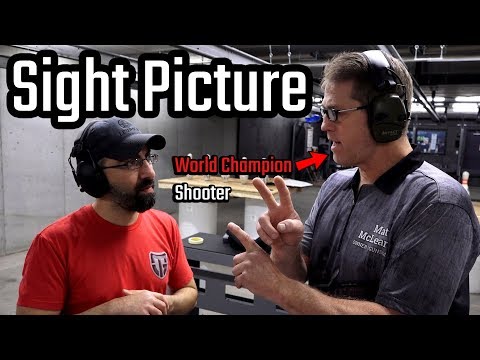
Instructor Mike explains the fundamental technique of sight alignment for firearms. The core principle is to focus intently on the front sight, ensuring it is clear while the rear sight remains blurry. This clear front sight is then aligned with the target's center of mass. Understanding that the front sight's position dictates bullet impact is crucial for accurate shooting.
This instructional video demonstrates the fundamental principles of firearm marksmanship, focusing on proper sight alignment and trigger control. Instructor Mike guides a participant through the process of achieving a clear front sight within a blurry rear sight, centered on the target's center of mass. The importance of a consistent two-hand grip and a slow, deliberate trigger press is emphasized for accurate shooting.
Instructor Mike introduces the SMASH (Shoot and Move Around Till Something Happens) system, emphasizing realistic target training. The system utilizes targets that fall after multiple hits, simulating the unpredictable nature of real-world engagements where the number of shots required to neutralize a threat is unknown. This method aims to train the shooter's brain to stop firing based on visual cues of the target falling, rather than external commands or shot counting, which are often absent or unheard under stress due to auditory exclusion and tunnel vision.
This video delves into the concept of center of mass in firearm discussions, highlighting the nuances and potential misunderstandings that arise when this term is used. It aims to clarify what is meant by center of mass in different contexts, likely exploring its implications for accuracy, ballistics, or defensive shooting principles. The content appears to be educational, geared towards individuals interested in a deeper understanding of firearm fundamentals beyond surface-level explanations.
This video analyzes a common practice in beginner firearms training: focusing on center of mass hits. The presenter expresses disagreement with an instructor who deemed shotgun-like patterns on a student's target acceptable, suggesting a deeper look into effective target engagement for new shooters. The core of the video likely involves demonstrating and explaining why precise shot placement, especially for beginners, is crucial and perhaps goes beyond simply hitting a large target area.
This training drill, demonstrated by multi-time world champion Matt McLearn, focuses on understanding and controlling firearm recoil for faster, accurate follow-up shots. By analyzing sight movement during recoil and actively managing it with hand pressure, shooters can improve their speed and accuracy. The drill progresses from single shots to rapid strings, building muscle memory and sight acquisition efficiency.
This video, featuring multi-time world champion shooter Matt McLearn, explains the concept of an 'acceptable' sight picture for self-defense scenarios, contrasting it with the precise alignment required for bullseye shooting. McLearn demonstrates that for combat at close distances (approximately 5 yards), slight deviations in sight alignment still result in hits to the center of mass, allowing for faster target engagement and potentially quicker threat elimination. The instruction emphasizes prioritizing speed and center-of-mass hits over perfect sight alignment in a defensive context.
This drill, presented by Steve Fischer, Beth Alkazar, and Mike Brickner from the USCCA, focuses on the 'Scan and Assess' technique. It challenges shooters to engage multiple threats (two targets, two rounds each) and then consciously scan their environment for additional threats or changes. The drill emphasizes the importance of active situational awareness beyond simply going through the motions, highlighting how easily subtle background changes can be missed.
This video demonstrates functional accuracy testing of an AK-47 (C39 V2) after approximately 5,000 rounds. The test focuses on shooting at 50, 100, and 150 yards using the combat sight setting. The instructor highlights that aiming at the belt buckle, a traditional Soviet training method, resulted in shots landing low at all tested distances. The video concludes that for this specific rifle and setup, aiming center of mass is necessary for effective hits, with groups averaging around 5 inches at 150 yards.
This video emphasizes the critical principle of 'stopping the threat' in deadly force encounters. Editor Kevin Mikolowski of Concealed Carry Magazine explains that the sole objective is to immediately cease the aggressor's actions, not to kill or wound. He details targeting the central nervous system (brain or spine) as the quickest method, or center of mass for incapacitation if CNS shots are not possible. The instruction concludes with the directive to shoot until the threat stops and then cease fire.
This video showcases the Action Target TI Training Use of Force Simulator, demonstrating its capabilities in realistic active shooter scenarios. Nutnfancy and Action Target representatives highlight the simulator's recoil characteristics, accuracy calibration, and its integration with classroom learning tools like PowerPoint. The training emphasizes engaging threats until eliminated and maintaining proper sight picture, with shot placement analysis provided post-scenario. The simulator also offers features for Taser training and analysis of real-world incidents.
You've reached the end! 11 videos loaded.
Gun Laws by State
Read firearms regulations for all 50 states + D.C.
Find Gun Dealers
Search licensed FFL dealers near you.