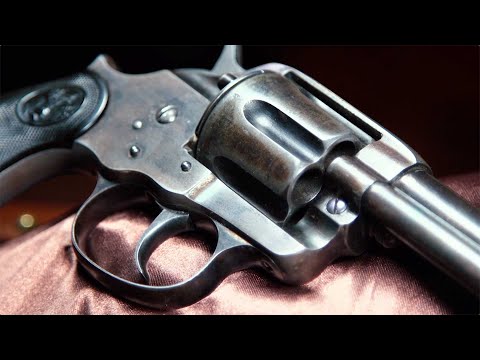
This guide details the safe carry procedure for Colt 1878/1902 double-action revolvers, as explained by C&Rsenal. It covers understanding the 'fired,' 'rebound,' and 'half-cock' positions and how to load and prepare the firearm for carry by ensuring the hammer rests securely in the rebound notch, preventing accidental discharge. Proper manipulation of the hammer and cylinder rotation are key to safe operation.
This video segment from "American Rifleman Television" explores the Colt Model 1878 double-action revolver. It contrasts Colt's earlier problematic Model 1877 with the more robust 1878, which addressed some design flaws and was chambered in a variety of popular calibers including .32-20 WCF, .38 Long Colt, .41 Long Colt, .38-40 WCF, .44-40 WCF, .45 Colt, .455 Webley, and .476 Eley. The video also discusses the U.S. Army's adoption of a variant as the Model 1902, its use during the Spanish-American War, and distinctive features like the enlarged trigger guard. Ultimately, the design's reliance on older loading mechanisms contributed to its obsolescence compared to swing-out cylinder revolvers.
This review of the Colt 1878 highlights its physical specifications, including a weight of 2.3 pounds and an overall length of 10.4 inches. The firearm utilizes 45 Colt ammunition and has a 6-round capacity, requiring manual cylinder rotation for loading. The review notes ergonomic challenges with its grip and hammer, as well as a heavy trigger pull and stout recoil.
This guide details modifications made to the Colt 1902 Philippine Model to address its heavy trigger pull, a result of a strengthened mainspring for primer ignition reliability. The video, presented with high historical and technical rigor by C&Rsenal, explains how a longer trigger and oversized guard were implemented to compensate for the 28 lb pull, while also noting ergonomic challenges.
This video details a common timing issue in Colt New Army revolvers, highlighting the unique scalloped cylinder stops and the role of the hand and gate in achieving proper alignment. The instructor explains how to diagnose and address back-travel or inconsistent cylinder lock-up, often stemming from issues with the hand spring or the hand's engagement with the cylinder stops.
You've reached the end! 5 videos loaded.
Gun Laws by State
Read firearms regulations for all 50 states + D.C.
Find Gun Dealers
Search licensed FFL dealers near you.