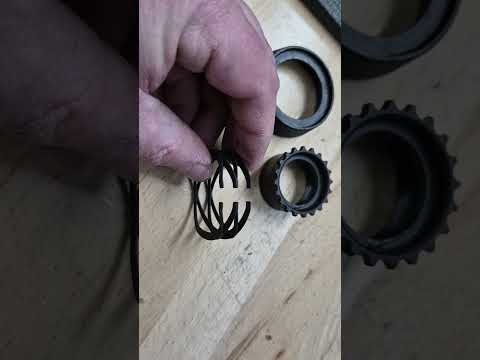
This expert guide from School of the American Rifle details how to identify and replace a malformed weld spring in an AR-15's delta ring assembly. A misaligned weld spring can cause gas tube issues, leading to potential component damage. The video provides a clear visual comparison and step-by-step instructions for replacement, emphasizing proper alignment for optimal function.
This guide details how to diagnose a severe firearm malfunction where the slide detaches from the frame, as demonstrated with a budget PSA Dagger build. It emphasizes safe handling, visual inspection of components, comparison with functional firearms, and consideration of aftermarket part compatibility. The presenter, an experienced individual knowledgeable in firearm components and pricing, highlights a specific failure where the slide came off the rails during firing.
This guide addresses a common failure point for AR-15 charging handles, where the component can shear off at the gas key interface. The video highlights a user's experience of a charging handle breaking on its first day at the range, suggesting either a defective part or an issue with an older firearm. The expert emphasizes that a broken charging handle requires immediate replacement.
This comprehensive review from Brass Facts details a 4-year, 6,500-round evaluation of the B&T TP9. Despite initial interest in the PDW platform, the speaker concludes the TP9 is not recommended for serious use due to significant reliability issues, including trigger malfunctions, suppressor baffle strikes, and internal component failures. While B&T customer service is praised, the platform's inherent design flaws lead to a negative overall assessment.
This video provides an abbreviated autopsy of an Anderson Manufacturing Bolt Carrier Group (BCG) that experienced a unique failure: a sheared lug near the ejector after only 150 rounds. The instructor notes that typical lug failures occur near the extractor due to higher load. While the carrier key screws passed a breakaway test, the carrier key itself leaked, indicating poor efficiency. The instructor emphasizes checking all firearm components regardless of manufacturer.
This video details a 4000-round durability test of the Palmetto State Armory (PSA) Dagger pistol. The test involved firing 124-grain 9mm ammunition through various magazines, meticulously documenting malfunctions, component failures, and accuracy degradation. The firearm ultimately failed at the 4000-round mark due to a broken slide release, among other issues, indicating significant durability concerns.
This video highlights a critical issue of carrier key corrosion found on a Brownells Retro Bolt Carrier Group. The instructor demonstrates how to inspect the inside of the carrier key using a borescope, revealing significant rust on one component compared to others. This inspection is crucial to prevent accelerated wear on the gas tube.
This guide details the inspection of a Geissele Super Duty upper receiver after 100,000 rounds, as presented by an expert from the School of the American Rifle. It covers critical wear points in the upper receiver, barrel, bolt carrier group, gas key, and charging handle, highlighting potential failure modes and reliability issues arising from extreme use. The analysis emphasizes the importance of detailed mechanical inspection for high-round-count firearms.
This video highlights a significant issue with an AIM Surplus Gen3 Glock barrel, where the 416R stainless steel appears to be excessively wearing and 'eating itself alive.' The instructor notes that this level of aggressive material removal is not seen on OEM Glock barrels with significantly higher round counts, suggesting the AIM Surplus barrel is extremely soft due to improper heat treatment. The slide is unaffected, further indicating the barrel's material deficiency.
This video discusses the conclusion of a torture test on a PSA Dagger pistol, detailing its failures including light primer strikes, a detached front sight, and a dislodged slide stop. The host presents a poll for viewers to decide between continuing testing on the PSA Dagger after repairs or initiating a similar torture test on a Ruger RXM. The discussion highlights the importance of component integrity in firearm function and the financial realities of content creation.
This guide details a common technique for inspecting the gas rings on an AR-15 Bolt Carrier Group (BCG). The video demonstrates that an H&R M16A2 build from Palmetto State Armory failed the "stand test" for its BCG after only 2,000 rounds, indicating worn gas rings. This test is a quick way for experienced shooters to assess BCG health.
Ben Stoeger, a highly experienced shooter, discusses his pragmatic approach to using budget-friendly Aero Precision AR-15 components for high-volume training. He intentionally pushes gear to its limits to identify failure points, noting specific issues like bolt override and barrel keyholing with Aero parts under heavy use. Stoeger differentiates between training rifles, where failure is acceptable for learning, and competition or duty firearms that demand higher reliability.
Gun Laws by State
Read firearms regulations for all 50 states + D.C.
Find Gun Dealers
Search licensed FFL dealers near you.