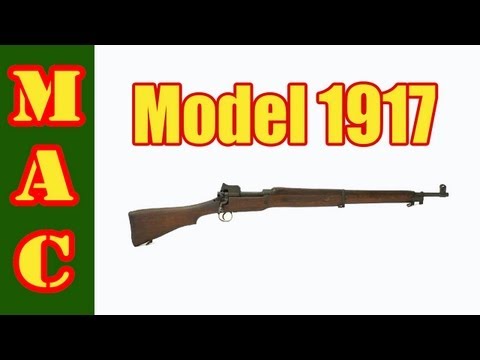
This video showcases the Enfield 1917 rifle, specifically a U.S. Model of 1917 Eddystone variant. It demonstrates loading with Remington Express Core-Lokt .30-06 Springfield 150-grain ammunition and performing live fire in a snowy outdoor environment. The footage highlights the rifle's bolt-action operation and casing ejection, emphasizing its functionality in cold conditions.
The U.S. Rifle M1917, chambered in .30-06 Springfield, was tested for practical accuracy up to 500 yards. Despite its historical significance, including alleged use by Sgt. Alvin York, its long sight radius and large aperture rear sight present challenges for modern shooters. While capable of hitting targets at 500 yards, achieving consistent accuracy requires adjusting to its unique sighting system, which differs significantly from modern platforms like the M16.
This video demonstrates shooting an M1917 Enfield rifle at a 300-yard target using iron sights. The shooter achieves a hit on the left edge of the target, showcasing impressive accuracy for a vintage firearm. The content highlights marksmanship skills and the capabilities of historic firearms in long-range scenarios.
This video pits two historic Enfield rifles against each other in a unique competition series, featuring an M1917 Eddystone in .30-06 and an Ishapore 2A1 in .308 NATO. The stage highlighted is a pistol-only segment, showcasing a Cimarron 1911 set up for the WW1 era. The primary focus of this particular stage is the challenge of engaging a spinner target with what's described as "obsolescent WW1 1911 tech."
This video pits two historic rimless Enfield rifles against each other in a competitive shooting scenario: the M1917 Eddystone in .30-06 and the Ishapore 2A1 in .308 NATO. The match also features a Cimarron WW1 style 1911 pistol. The challenge involves a 'Dirt Crawling and Failing' stage through Arizona moon dust, testing the rifles' reliability and the shooter's performance under pressure. The goal is to see if these warhorses can complete the match without malfunctions, a point of interest given previous issues with .303 Enfields. The video is viewer-supported.
This video features a comparison of two historic rimless Enfield rifles: the M1917 "Eddystone" chambered in .30-06 and the Ishapore 2A1 in .308 NATO. The match series takes a break from modern firearms to test these warhorses in a Close Quarters Battle (CQB) scenario, focusing on bolt speed and potential malfunctions. The video also briefly mentions a Cimarron WW1 style 1911 pistol. The testers express curiosity about how these bolt-action rifles will perform under pressure, especially considering past issues with .303 Enfields, and note one participant's unconventional left-handed bolt cycling method.
This video features a comparison of two historic rimless Enfield rifles: the M1917 "Eddystone" chambered in .30-06 and the Ishapore 2A1 in .308 NATO. The match also incorporates a Cimarron WW1 style 1911 pistol. The engagement takes place at 100 and 150 yards from various prone positions in challenging, dirty conditions. The series aims to test the reliability of these rifles, particularly in contrast to past issues with .303 Enfields.
The U.S. Rifle Model of 1917, chambered in .30-06 Springfield, was developed to meet WWI equipment shortages, ultimately outnumbering the M1903 Springfield. It features a 46.25-inch length, 9.2 lbs weight, and a 6-round capacity with a Mauser-style bolt action that cocks on closing. Production innovations, like part-time positions at Winchester, accelerated output but caused interchangeability issues. Post-war, the M1917 action influenced later civilian rifle designs.
The M1917 Eddystone is a historically significant WWI rifle, chambered in .30-06 Springfield, with a robust build and a smooth bolt action. While its weight and iron sight limitations make it impractical for modern use, it offers a unique historical experience and good accuracy for its era. It's a collector's item and a fun range gun, though not ideal for hunting or defense.
The Model 1917 American Enfield, originally the British Pattern 14, was adopted by the US in WWI for its .30-06 chambering due to Springfield shortages. It features a robust, cock-on-closing bolt action, a 6-round capacity, and a long sight radius with its rear peep sight. Known for its strength, it was more common than the M1903 Springfield among US soldiers and saw service until 1953.
You've reached the end! 10 videos loaded.
Gun Laws by State
Read firearms regulations for all 50 states + D.C.
Find Gun Dealers
Search licensed FFL dealers near you.