This video compares the terminal ballistics of 5.56x45mm NATO (M855 Green Tip) and 7.62x39mm (Tula) ammunition using gel block testing. The 5.56mm round demonstrated significant expansion and fragmentation, causing substantial damage to the test setup. The 7.62x39mm round, while also expanding, showed greater penetration, passing through the gel block and the table. The test highlights the different performance characteristics of these popular calibers in terms of tissue damage and penetration.
This video explores the evolving landscape of handgun calibers, moving beyond the traditional 9mm. The presenter, Ted from Line 45, details several alternative calibers gaining traction in 2025, including 30 Super Carry for increased capacity in compacts, 5.7x28mm for flat trajectory and speed, 10mm for significant power and penetration, 357 SIG for barrier penetration and velocity, and 22TCM for rifle-like speed in a pistol platform. The discussion highlights the specific advantages and use cases for each caliber, suggesting a shift towards more specialized choices for concealed carry and self-defense.
This video tests the ballistic penetration capabilities of various firearms against seven stacked MacBooks. It demonstrates how different calibers, from .22LR to 7.62x54R, interact with the laptops, highlighting varying degrees of penetration and material deformation. The Mosin Nagant proved most effective, completely penetrating all laptops.
This video argues that 300 Blackout is an overpriced and less effective caliber compared to 5.56x45mm NATO for most applications. The speaker contends that 300 Blackout offers no significant advantages in terminal ballistics or overall effectiveness for the average shooter or operator, with its primary benefit being suppressed performance, which is deemed less critical than terminal effectiveness. The video suggests that proponents of 300 Blackout are often influenced by online communities or a misunderstanding of its practical utility, advocating for investment in 5.56x45mm NATO for better range, ammunition capacity, and overall value.
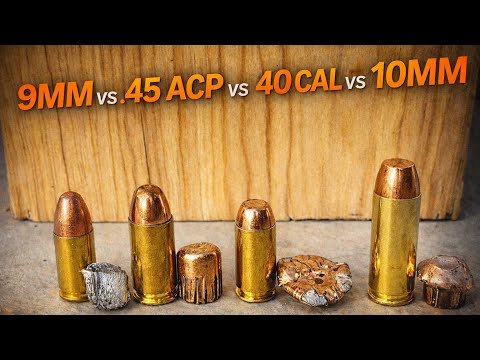
This video conducts a penetration test comparing 9mm, 10mm, .45 ACP, and .40 S&W calibers through wood and paper. The test reveals significant differences in penetration depth, with the 10mm and .40 S&W generally outperforming the 9mm and .45 ACP in wood, while paper penetration varied. The presenter also notes differences in bullet construction and primer size between calibers.
This video tests the penetration capabilities of four pistol calibers (.30 Super Carry, 5.7x28mm, .357 SIG, and 10mm Auto) against concrete blocks using standard FMJ ammunition. The results indicate that none of the tested calibers, even the 10mm, could penetrate more than a single concrete block under these conditions. The instructor plans future tests with specialized ammunition like hard cast and penetrator rounds.
This video from Demolition Ranch, featuring Matt Carriker, tests the penetration capabilities of various firearms and calibers against a unique target: a 1,500 peppermint cube encased in resin. The FN High Power in 9mm is tested alongside other calibers like .22 LR, .30 Carbine, .50 Beowulf, and .50 BMG. The results provide a visual comparison of how different rounds interact with a dense, yet somewhat fragile, medium.
This video compares the terminal ballistics of various handgun calibers (.22LR, .380 ACP, 9mm, .40 S&W, .45 ACP) using cantaloupes as a medium. The test utilizes Full Metal Jacket (FMJ) ammunition to observe penetration and energy transfer without the complexities of expanding hollow points. The results highlight differences in projectile performance and energy delivery across the tested calibers, with the .40 S&W showing notable energy transfer due to its flat nose projectile.
This video details a ballistic gel test comparing .380 ACP and 9mm Luger Full Metal Jacket (FMJ) ammunition. The test measures projectile velocity and penetration depth, revealing unexpected results where the .380 ACP, specifically a flat-nose FMJ, achieved greater penetration than the 9mm Luger round nose FMJ. The instructor highlights the importance of bullet design in terminal ballistics.
This experiment tests the penetration capabilities of various firearm calibers against a standard Picnic brand gas tank. Handguns (9mm, .45 ACP, .357 Magnum) and a shotgun failed to penetrate the tank, causing only superficial damage. However, a .308 Winchester round from a Remington 700 rifle successfully penetrated both sides of the tank, demonstrating that gas tanks can offer cover against smaller calibers but not high-powered rifle rounds.
This video presents a penetration test comparing 9mm and .45 ACP ammunition using water jugs as a target. The presenter, from 4MR Ranch, conducts a side-by-side comparison to determine which caliber demonstrates superior penetration. The results were unexpected, with the .45 ACP appearing to penetrate more than the 9mm in this specific test scenario.
Gun Laws by State
Read firearms regulations for all 50 states + D.C.
Find Gun Dealers
Search licensed FFL dealers near you.