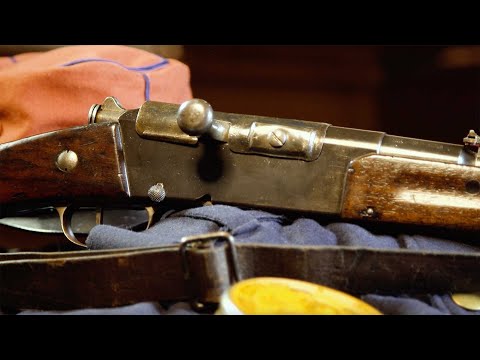
This video from Legacy Collectibles provides an expert look at the rare French RSC Model 1917 rifle. It highlights the rifle's historical significance as one of the first WWI battle rifles produced in quantity and notes its limited popularity with soldiers due to weight and maintenance requirements. The discussion also touches upon the less common Model 1918 variant.
This entry details the FAMAS G1, an export-oriented variant of the FAMAS rifle, as presented by Ian McCollum of Forgotten Weapons. The G1 features significant production simplifications, including an integrated polymer lower receiver, a smoothed barrel without grenade launcher features, and the removal of night sights, all aimed at reducing manufacturing complexity and cost for international markets.
This guide details the basic loading and firing technique for the MAS 49/56 rifle, as demonstrated in the video. It covers magazine insertion, charging the action, safety engagement, and firing. The demonstration highlights the rifle's semi-automatic operation and the bolt locking back after the last round. Proper range safety is emphasized throughout the process.
The Model 1886 Lebel rifle was a revolutionary firearm, being the first military arm to utilize smokeless powder. This innovation, developed by Paul Vieille, significantly increased projectile velocity and range compared to black powder. The rifle's design, though an amalgamation of existing concepts, was developed under intense pressure and fielded within a year, marking a pivotal moment in firearms technology.
This guide details the loading and firing technique for the Modele 1874 Gras rifle, as demonstrated by Ian McCollum. It covers the bolt operation, cartridge loading via the tray, sight adjustment, and the efficiency of the bolt-action design. The video highlights the importance of using correct ammunition for reliable ejection and compares its speed to other historical firearms.
This entry details the reliability issues encountered with the McCann Industries .308 caliber conversion of the French MAS 49/56 rifle, as presented by Ian McCollum. The analysis highlights common failures to feed and extract, often exacerbated by the use of converted FAL magazines. Expert insights from McCann Industries' work on these surplus rifles are provided, focusing on the challenges of adapting the platform to a different caliber and utilizing aftermarket components.
This guide details the operation and firing of the French MAS-44 rifle, drawing from expert instruction. It covers magazine removal, loading, chambering a round, engaging the safety, and live fire demonstration. The video emphasizes proper manual of arms and safe range practices for this vintage semi-automatic rifle.
This review of the French Berthier 1916 rifle highlights its carbine length (37.2 inches) and a weight of 7.2 lbs, making it relatively easy to handle. Key improvements over previous models include a five-round magazine capacity, increased mud resistance via an extended steel magazine with a trapdoor bottom, and a turn-down bolt for closer operator proximity. The extended handguard offers burn protection, and the sights are designed for rapid acquisition.
The French Lebel 1886 M93 is an early smokeless powder infantry rifle weighing 9.2 lbs with an overall length of 51.5 inches. It features a tubular magazine holding eight rounds and a bolt operation that requires specific finesse. While its sights are geared for long-range accuracy, they can be slow for close combat. Despite its awkward handling, it represented a significant advancement in ammunition technology with the 8mm Lebel cartridge.
This review of the French Berthier Mousqueton Modèle 1892 carbine, presented with high authority by C&Rsenal, details its physical specifications, loading mechanism, and firing experience. The carbine features a 3-round en-bloc clip system and semi-buckhorn sights. However, the review critically notes limitations such as the low capacity, susceptibility to mud, and a challenging firing experience due to recoil and ergonomics when firing the 8mm Lebel cartridge.
This video from Forgotten Weapons delves into the rare Mle 1866 Chassepot rifle specifically configured for African Cavalry use. Host Ian McCollum, author of 'Chassepot to FAMAS,' highlights its unique features, historical context in Algeria, and production details. The cavalry variant boasts distinct sling swivels, reinforced stock, and a special serial number prefix, differentiating it from standard infantry models.
This guide details the field stripping procedure for the rare MAS Type 62 rifle, a French prototype developed in the early 1960s. The process involves a simple pivot pin mechanism for separating the receiver halves, allowing access to the internal components. Expert analysis highlights its unique striker-fired system and design influences from the FN FAL.
Gun Laws by State
Read firearms regulations for all 50 states + D.C.
Find Gun Dealers
Search licensed FFL dealers near you.