This entry details the assessment of wear on an AR-15 Bolt Carrier Group (BCG) after 10,000 rounds, focusing on cam pin wear patterns and gas key tightness. It highlights potential issues like a loose gas key, emphasizing the importance of regular maintenance for long-term reliability, as demonstrated by the 'Brass Facts' channel's expert analysis.
This guide details 17 habits for extending the life of an AR-15, drawing on military armorer data. Key practices include listening to the rifle for early warnings, adhering to specific cleaning intervals, inspecting critical components like bolts and springs, using appropriate lubricants, and managing heat. Following these steps can help an AR-15 exceed 20,000 rounds of reliable service.
This guide details the inspection of a Geissele Super Duty upper receiver after 100,000 rounds, as presented by an expert from the School of the American Rifle. It covers critical wear points in the upper receiver, barrel, bolt carrier group, gas key, and charging handle, highlighting potential failure modes and reliability issues arising from extreme use. The analysis emphasizes the importance of detailed mechanical inspection for high-round-count firearms.
This video reviews 25 'criminally underrated' firearms, focusing primarily on pistol caliber carbines (PCCs) and compact handguns. It highlights models from Smith & Wesson, Kel-Tec, High Point, Ruger, Palmetto State Armory, CZ, and others, discussing their features, calibers, magazine compatibility, and price points. The review offers insights into value, portability, and specific use cases for each firearm.
This video from AT3 Tactical provides an expert-level breakdown of Bolt Carrier Groups (BCGs) for AR-15 platforms. Instructor C.J. details the critical role of BCGs, explaining how material composition (Carpenter 158, 9310, 8620 steel), advanced coatings (Phosphate, Nitride, Nickel Boron, DLC), and special features like full-auto profiles and properly staked gas keys influence performance and price. The content is highly technical, utilizing metrics like tensile strength (MPA) and coefficient of friction (COF) to guide consumers toward informed purchasing decisions.
This guide details the inspection and preparation of AR-15 carrier keys, emphasizing critical dimensions, surface trueness, and internal finish. Proper gauging, stoning the bottom for a flat seal, and polishing the funnel improve gas system efficiency and longevity. The instructor highlights the importance of a good seal to prevent gas blow-by and wear on the gas tube.
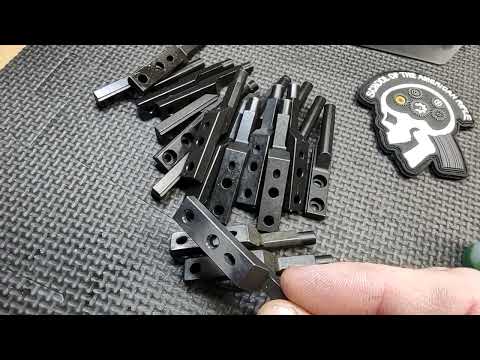
This guide details the use of the Suns of Liberty Gunworks Armorer Punch Set for AR-15 maintenance and installation. It covers specialized tools for pivot pin installation, various roll pin punches for different sizes, a unique bolt catch punch designed to protect receiver finish, starter punches for easier roll pin insertion, larger punches for stubborn pins, and 50°/40° staking punches for gas keys and castle nuts. The punches are constructed from heat-treated tool steel with a nitride coating.
This video announces the release of the School of the American Rifle's AR-15 Bolt Carrier Group (BCG) and Gas System Gauge Set. These gauges are designed to measure critical dimensions of the BCG, including the carrier body, bolt tail, and gas key, to assess efficiency and proper function. The set also includes pin gauges for carrier key alignment and a gas path gauge to check for obstructions. While some specialized gauges are not yet available due to manufacturing challenges, the released set aims to provide users with a deeper understanding of their AR-15's internal workings and potential gas system inefficiencies.
This video clarifies the AR-15's operating system, distinguishing it from true direct impingement. It explains that the AR-15 utilizes an internal piston mechanism, where gas acts upon the bolt carrier group's gas key and then expands within the bolt itself, facilitated by gas rings. This contrasts with traditional direct impingement systems like the French MAS 49/56 and Swedish AG42, where gas directly impinges the bolt face.
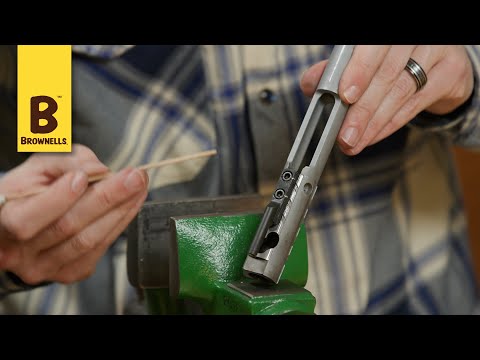
This guide details the professional process for replacing an AR-15 gas key, as demonstrated by Caleb from Brownells. It covers critical steps like proper cleaning, surface preparation using India stones, application of Loctite 638, precise torquing to 50-58 inch-pounds, and secure mechanical staking to prevent loosening. This ensures reliable gas system function and prevents malfunctions.
This guide breaks down the complex, mission-critical function of the AR-15 Bolt Carrier Group (BCG), explaining its eight distinct jobs during the firing cycle. Expert insights cover materials like Carpenter 158 steel, quality control tests such as MPI and HPT, and the importance of a properly staked gas key. It also explores various BCG enhancements and provides selection advice for different user needs.
This video provides a foundational understanding of AR-15 Bolt Carrier Groups (BCGs), detailing their function and components. It clearly distinguishes between M16 (full-auto) and semi-automatic BCGs, explaining that M16 BCGs do not convert a semi-automatic rifle into a machine gun, citing ATF regulations. The explanation covers key parts like the carrier, gas key, bolt, extractor, locking lugs, firing pin, and gas rings, offering insights into their roles in rifle operation.
Gun Laws by State
Read firearms regulations for all 50 states + D.C.
Find Gun Dealers
Search licensed FFL dealers near you.