This expert analysis of the Fliegerselbstlader Karabiner 1915 (FSK 1915) provides a deep dive into its design, historical context, and performance. The video highlights its unique gas-operated semi-automatic action, a 30-round drum magazine in 7x57mm Mauser, and a complex two-stage trigger. Despite reliability concerns, its semi-automatic capability offered a significant advantage over contemporary bolt-action rifles, particularly for aviators in WWI.
This guide details the unique 50-meter adjustment mechanism of the Gewehr 1898's Lange Visier sight, often referred to as a 'rollercoaster sight'. Expert instruction highlights how alternating button presses allow for precise, incremental adjustments without major repositioning, a feature often found on German-made Mausers. The video emphasizes understanding the sight's range from 400 to 2000 meters and its utility in varying conditions.
This video provides a concise overview of the FG-42 paratrooper rifle, focusing on its accessories and features. It details the attachment of the Moss 36 bayonet, the functionality of its folding iron sights, and the method for mounting optics. The spring buffer for recoil reduction is also highlighted, followed by a demonstration of firing the weapon.
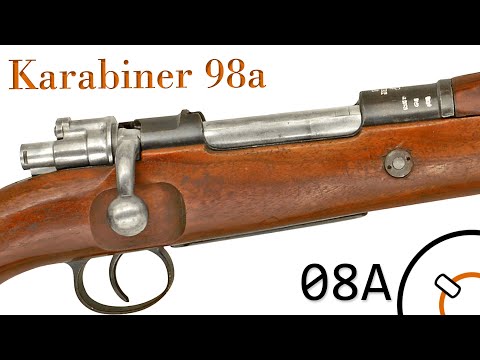
This video provides an in-depth historical and technical review of the German Karabiner 98a, tracing its development from the Gewehr 98 and earlier carbine models. It details the design evolution, specifications, and intended roles of the K98a, highlighting its differences from the standard rifle and its place in German military history. The review includes observations on its handling, features, and historical context.
This expert analysis of the German Mauser 1871 details its single-shot bolt-action operation, firing the 11.15x60mmR cartridge. The rifle is characterized by its substantial weight and length, a smooth action reminiscent of later Mausers, and a prominent flag safety. While robust, its accuracy can be affected by environmental factors due to barrel bedding, and its sights are noted as being less than ideal. The firing experience involves significant recoil and a large smoke signature, historically relegating it to rear-echelon roles during WWI.
This video features a detailed look at the G98 Mauser rifle, chambered in 8mm Mauser. The presenter, Hickok45, discusses its historical significance as the predecessor to the K98k, its design features like the roller coaster sight, and its rarity. He shares personal shooting experiences, highlighting the rifle's accuracy and the enjoyment derived from shooting classic firearms. The video also touches on broader topics like the appreciation of historical firearms and the importance of proper sight alignment.
This expert-level entry delves into the Gewehr 43 (G.43), a semi-automatic rifle produced by Walther for Germany during WWII. It covers the G.43's technical specifications, design evolution from the G.41, and its production challenges due to late-war pressures. The analysis contrasts its technological superiority as an individual weapon against its limited impact on the war's outcome due to logistical issues and production scale compared to the Kar98k.
This video features a 'Sunday Shoot-a-Round' celebrating the 100th episode, showcasing the Mauser Gewehr 98 and Beretta 92FS. The host discusses the history and shooting characteristics of both firearms, interspersing personal reflections on Thanksgiving, societal issues, and the value of firearms. The content focuses on the shooting experience and historical context rather than technical instruction.
This video provides an unboxing and first look at a 1941 Mauser Kar98k rifle. The presenter, Tagshot, highlights the rifle's condition, matching serial numbers, and historical context. He notes the importance of provenance and condition for collector-grade firearms, emphasizing that while expensive, these rifles represent historical significance. The video also touches on the operational smoothness of the bolt action, comparing it favorably to other historical rifles.
This video details the Mauser Model 98A and 98AZ carbines, developed as shorter alternatives to the Gewehr 98 infantry rifle for trench warfare and support troops. It highlights their design evolution, production numbers during WWI, and post-war modifications, including the 1920 overstamp signifying compliance with the Treaty of Versailles.
This guide details how to identify and analyze a late-war German Kar 98k, specifically a 'CE44' model. It covers identifying manufacturer codes, recognizing wartime production simplifications like stamped parts, understanding component sourcing through Waffenamt stamps, and assessing part matching common in surplus firearms. The information is presented with the authority of a recognized expert in historical firearms.
This video provides an in-depth historical and technical examination of the German Gewehr 1898 'Mauser' rifle. It details the rifle's development, design evolution from earlier Mauser models, and its key features, including its bolt action, safety mechanisms, and sights. The presenters also offer practical insights into its handling, ergonomics, and performance, contrasting it with other contemporary rifles.
Gun Laws by State
Read firearms regulations for all 50 states + D.C.
Find Gun Dealers
Search licensed FFL dealers near you.