This video details a critical review of the Sig Sauer P211 GTO Combat by Ben Stoeger and Trench Grenade. The discussion highlights significant reliability issues, including failures to go into battery and overall poor performance out of the box. Both reviewers express disappointment with the firearm's design choices, such as magazine compatibility and grip size, and question its market viability compared to competitors like Kimber and Staccato. The conversation also touches on the challenges of honest firearm reviews and the potential backlash from manufacturers.
This review of the Springfield Hellcat Pro highlights its performance as a concealed carry firearm, noting improvements in felt recoil compared to the original Hellcat but still describing it as 'snappy'. Key observations include its comfortable carry profile, effective concealment with a proper holster setup, and disappointment with the unchanged weak slide serrations and heavy trigger pull. The California-compliant version's magazine disconnect feature is identified as a functional impediment.
Colion Noir, an established firearms expert, analyzes the optimal striker-fired pistol configuration, advocating for a full-size grip paired with a compact slide. This design, exemplified by the Springfield Echelon 4.0 FC and conceptually similar to the Glock 19X, enhances leverage for recoil control and improves balance for faster target acquisition. The video provides a detailed breakdown of these ergonomic advantages for various shooting applications.
This video provides a comprehensive overview of different pistol sizes, from micro 'mouse guns' to full-size pistols, explaining their intended uses, pros, and cons. It emphasizes how grip size, barrel length, and capacity affect shootability, recoil, and concealability, offering guidance for selecting the right firearm for various needs, including concealed carry and home defense.
This review compares the Shadow Systems CR920 XL to other CR models, focusing on how grip and muzzle length impact carry comfort, recoil management, and shooting dynamics. The CR920 XL offers a longer barrel (4.2 inches) and 15-round capacity, providing better velocity and potentially softer shooting than shorter variants. However, like other slimline pistols, its narrow grip can challenge support hand placement for recoil control. Holster compatibility is a key consideration, especially with full-length dust covers.
This video clarifies the distinctions between the Colt 1861 Navy and 1860 Army revolvers. The primary differences lie in their historical calibers, with the Navy being .36 and the Army being .44. Other key identifiers include barrel length (7.5 inches for the Navy vs. 8 inches for the Army) and cylinder dimensions, which are stepped on the Army model to accommodate the larger caliber.
This video explores the author's experience switching back to steel frame handguns after an extended period with polymer frames, specifically Walther PDP models. The author, a firearms instructor, discusses how familiarity and consistent training lead to proficiency with any platform, highlighting that personal preference and comfort often outweigh objective superiority. Key takeaways include the importance of grip comfort, recoil management, and the psychological aspect of 'making yourself right' with a chosen firearm.
Dustin from Guns of the West clarifies the distinction between the Colt 1860 Army and 1861 Navy revolvers, addressing common confusion. Key differences highlighted include barrel length (8 inches for the Army vs. 7.5 inches for the Navy), grip size, and crucially, caliber (.44 for the Army and .36 for the Navy), which is visually evident in the cylinder's stepped design on the Army model.
This video compares the 1911 Officer model to the GI model, highlighting the Officer's smaller size due to its 3-3.5 inch barrel and shortened grip, making it easier to carry. However, this comes at the cost of reduced capacity (7 rounds vs. 8) and increased 'snappiness' due to its lighter weight and shorter length. The choice between models depends on the user's priority for concealability versus shootability.
This video from Spartan Defense provides a concise overview of the Sig Sauer P365 pistol series, highlighting key differences between its numerous variants. The expert guide breaks down distinctions in grip size (Compact, Standard, Macro), magazine compatibility, and the functional benefits of compensated slides. It also touches on specific models like the Rose series and optic-ready options, aiding viewers in selecting the best P365 for their needs.
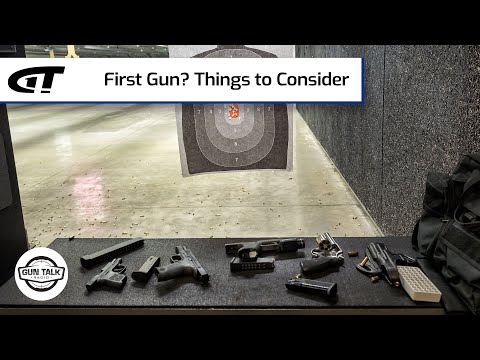
This segment from Gun Talk Radio emphasizes that choosing a first handgun, especially for self-defense, requires careful consideration beyond initial impressions. The advice centers on practical experience with an instructor at a range, highlighting that larger, heavier firearms are generally easier to shoot due to physics mitigating recoil and providing more grip surface. It cautions against common misconceptions, like solely relying on what police or special forces carry, and stresses the importance of trying multiple firearms to find what truly works for the individual.
This video compares the Glock 43, Glock 48, and Glock 19, focusing on their size, grip, and concealment characteristics. The Glock 43 is a slimline subcompact, often requiring magazine extensions for a full grip and increased capacity. The Glock 48 offers a similar slide length to the 43 but with a wider grip, improving shootability and hand-fill without significantly impacting concealment. The Glock 19 is presented as a larger, more shootable option, though its girth makes it harder to conceal than the slimmer models.
Gun Laws by State
Read firearms regulations for all 50 states + D.C.
Find Gun Dealers
Search licensed FFL dealers near you.