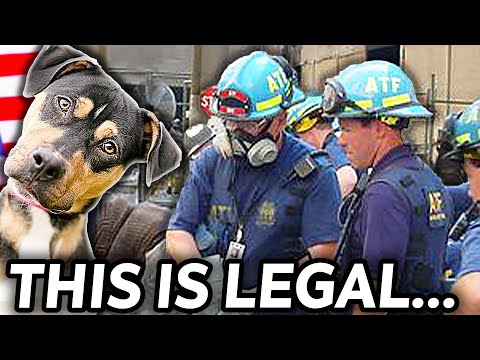
This video analyzes Jeanine Pirro's controversial statement on gun laws in Washington D.C. and her subsequent clarification. Mark W. Smith, a constitutional attorney and author, breaks down the legal nuances of D.C.'s firearm regulations, the tension between local laws and constitutional rights, and Pirro's past and present stances on gun control. The discussion highlights the importance of precise legal language and distinguishes between inherently unlawful acts and those made unlawful by legislation.
This video provides an expert analysis of a significant Second Amendment victory in the US Court of Appeals for the Fifth Circuit. Mark W. Smith, a constitutional attorney, breaks down the ruling concerning federal felon-in-possession laws (18 USC 922(g)(1)), emphasizing the court's historical approach to rights and concerns about over-criminalization.
The ATF has removed a 'Faces of Gun Violence' memorial from its headquarters, a move interpreted as a shift in messaging from the Biden to the Trump administration. This action highlights a distinction between 'malum in se' (inherently evil) crimes and 'malum prohibitum' (prohibited by law) offenses, with the latter often associated with federal gun control measures. The speaker argues that focusing on 'malum in se' crimes aligns better with preserving Second Amendment rights.
This video argues that the success of the Trump administration is crucial for preserving Second Amendment rights. The speaker, Mark Smith, a constitutional attorney, emphasizes that the administration's focus on combating violent criminals and deporting illegal aliens is beneficial for gun owners. This approach, he contends, reduces the ammunition for the anti-gun movement, which often uses acts of violence by criminals to push for stricter gun control laws. The video also distinguishes between inherently evil acts (malum in se) and those that are crimes simply because they are legislated (malum prohibitum), advocating for a government focus on the former.
This video discusses significant actions and potential shifts within the Trump administration and the Department of Justice concerning Second Amendment rights. Key points include the push for originalist federal judges, the Department of Justice's reassessment of its stance on gun control regulations, and the firing of the ATF's Chief Counsel. The discussion also highlights the distinction between malum prohibitum and malum in se crimes and its potential impact on federal gun laws.
This video discusses significant policy shifts within the US Department of Justice under the Trump administration, focusing on a renewed emphasis on prosecuting dangerous criminals rather than minor firearms infractions. It highlights a policy statement from Attorney General Pam Bondi's office, directing the DOJ to prioritize individuals posing a violent danger and to re-evaluate institutional reform litigation, particularly concerning concealed carry licensing processes.
This video discusses the role and perceived advantages of federal prosecutors within the US legal system, particularly concerning Second Amendment rights and federal gun control laws. The speaker, a constitutional attorney and self-proclaimed top voice for the Second Amendment, argues that federal prosecutors have an unfair advantage due to the government's infinite resources compared to most defendants. The discussion also touches upon recent news regarding the dismissal of prosecutors involved in January 6th cases and the potential implications for legal and civil liabilities.
This video analyzes President Joe Biden's pardon of his son, Hunter Biden, focusing on its implications for the Second Amendment and gun control. The speaker argues that Biden's justification for the pardon, emphasizing the non-violent and 'malum prohibitum' nature of the gun charge, sets a precedent that can be used to challenge existing and future gun control laws. The analysis also touches on the potential for this pardon to impact political prosecutions and congressional testimony.
This video discusses the concept of 'malum prohibitum' crimes, which are offenses that are illegal simply because they are legislated, not because they are inherently immoral. The speaker uses the incident of law enforcement killing Peanut the squirrel and a raccoon after a search warrant execution as a case study for government overreach. The argument is made that such laws, particularly in the context of gun control, grant excessive power to bureaucrats and law enforcement, leading to potentially tragic consequences and the erosion of rights.
This video discusses the constitutionality of displaying the Ten Commandments in public schools, focusing on the First Amendment's Establishment Clause. Host Mark Smith, a constitutional attorney, argues that originalist interpretation supports the idea that the founders did not intend to prohibit all religious expression in the public sphere, but rather to prevent the establishment of a national religion. He posits that the Ten Commandments, particularly their moral precepts, are foundational to American society and not solely religious in nature.
This video discusses the US Supreme Court's consideration of the case Brian Rayn v. United States, focusing on whether a misdemeanor conviction for omitting income from a food stamp application should result in a lifetime ban on firearm possession under 18 USC 922 G1. The speaker, Mark Smith, a constitutional attorney and member of the Supreme Court bar, argues against Attorney General Merrick Garland's efforts to delay or dismiss the case, highlighting the distinction between inherently evil crimes (malum in se) and those that are illegal by legislative definition (malum prohibitum). The analysis centers on the application of the Second Amendment post-Nunnery v. Bruen.
This video discusses the potential for a Governor Lee Zeldin to leverage gubernatorial pardon powers to address what the creator views as unconstitutional gun control laws in New York. It highlights Zeldin's election as a potential turning point for gun owners and contrasts an anti-gun legislature with a pro-gun governor. The content delves into the legal distinctions between 'malum prohibitum' and 'malum in se' in relation to gun laws, suggesting that Zeldin could use his executive authority to effectively nullify or mitigate the impact of restrictive firearm regulations.
Gun Laws by State
Read firearms regulations for all 50 states + D.C.
Find Gun Dealers
Search licensed FFL dealers near you.