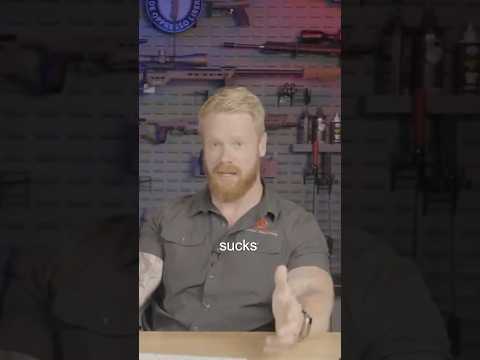
This video explains the fundamental differences between Minute of Angle (MOA) and Milliradian (MIL) as units of angular measurement used in rifle scopes. It clarifies that MOA is 1/60th of a degree, equating to approximately 1 inch at 100 yards, while MIL is 1/6400th of a circle, equating to 10 cm at 100 meters. The instructor notes that most precision scopes use quarter MOA adjustments, allowing for fine-tuning.
This guide details the process of accurately engaging targets at extended ranges, emphasizing the critical step of dialing scope adjustments. It highlights the importance of understanding your scope's system (MOA vs. MIL) and calculating precise ballistic corrections. The content is presented by Kevin Jarnagin, a professional hunting personality from Gun Talk Media, offering expert insights into successful long-range hunting techniques.
This guide, drawing on expertise from Vortex Optics professionals and competitive shooters, explains the differences between MOA and MIL for scope adjustments. It recommends MIL for beginners due to its base-10 simplicity and introduces the 'Hunter's Zero' concept for practical hunting scenarios. The information is presented with high authority, reflecting the speakers' industry experience.
This video from Ballistics Lab provides an expert comparison of MOA and MIL adjustment systems in rifle scopes. The instructor, demonstrating high authority, explains the mathematical origins, practical applications, and nuances of each system. Key takeaways include understanding the true value of 1 MOA, the base-10 simplicity of MIL for range estimation, and the contextual dominance of each system in competition versus hunting.
This video demonstrates the Shot Insights ballistic app and its integrated shot caller system for long-range shooting. It highlights features like the quick sight reticle for calculating holds based on yardage and wind, and the target sensors that provide real-time data on drop, elevation, and distance. The system is presented as intuitive and valuable for precision shooters.
This review covers the DNT ThermNight 635R, an all-in-one optic combining thermal imaging, digital day/night vision, an IR illuminator, and a laser rangefinder. The reviewer highlights its versatility for hunting, search and rescue, and law enforcement, noting its 640 thermal sensor's identification range up to 300-400 meters and a 20x digital zoom. While acknowledging a slight delay in the digital display during rapid target transitions, the reviewer praises its intuitive interface, impressive battery life, and significant cost-effectiveness compared to dedicated thermal scopes.
This video explains a method for 'doping gravity' in long-range shooting, allowing for simplified ballistic calculations. The speaker details how to use a multiplier derived from distance measurements to adjust ballistic solutions, making them more manageable for shooters. The discussion also touches upon the availability of apps that can perform these calculations.
This guide details how to achieve a perfect rifle zero, as demonstrated by Precision Rifle Network. It covers analyzing shot groups, converting measurements between MOA and Mils, and making precise scope adjustments. The instruction emphasizes understanding your equipment's tracking capabilities for accurate zeroing.
This video provides an expert-level overview of various Austrian LEO/MIL Steyr AUG configurations, presented by James Reeves and Martin. It details specialized models like the BMI for police, WEGA for Vienna SWAT, Cobra for special forces in .300 Blackout, and the Jagdkommando for elite military units, highlighting unique modifications and accessories for each role.
This YouTube video focuses on a comparison between Minute of Angle (MOA) and Mil-radians (MIL) for long-range shooting. The title, "MOA Sucks! MOA vs. MIL #longrangeshooting," clearly indicates a critical examination and comparison of these two popular measurement systems used in precision shooting. The video aims to educate viewers on the differences and potential drawbacks of MOA, suggesting it may be inferior for certain long-range applications compared to MIL.
This video tackles the often-confusing world of firearm measurements, specifically addressing the difference between Mil (Miliradians) and MOA (Minute of Angle). The title strongly suggests a critical stance on MOA, humorously referring to it as "for Commies," indicating a potential preference for Mil or a strong opinion on measurement standards. The content likely aims to educate viewers on why these distinctions matter in ballistics and aiming, possibly in the context of rifle scopes or long-range shooting.
This guide, presented by firearms instructor Elliott Delp, explains the fundamental differences between MIL and MOA turret adjustment systems on rifle optics. It covers how to identify each system, the typical increment values (0.1 MRAD for MIL, 1/4 MOA for MOA), and the importance of tactile and audible feedback for precise adjustments. Understanding these concepts is crucial for accurate zeroing and field adjustments.
Gun Laws by State
Read firearms regulations for all 50 states + D.C.
Find Gun Dealers
Search licensed FFL dealers near you.