This guide details the disassembly process for the gas trap variant of the M1 Garand, highlighting its differences from the later, more common models. It involves removing the bolt and operating rod first, then a specific screw to release the gas trap, followed by the sight block, before the gas trap assembly can be rotated off. This early design proved less reliable than the later gas piston system.
This video delves into the development of Colt's early external piston rifles, specifically the M5 and LE 1020. It highlights the design philosophies of engineers like Greg Grechenko, the technical differences between the M5 and LE 1020, and the reasons behind the M5's cancellation. The SCW stock development is also explored as a separate but related project by Grechenko.
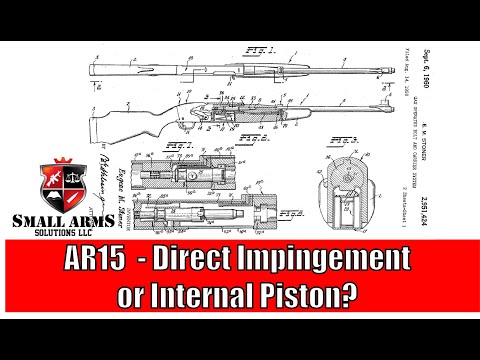
This video clarifies the operating systems of AR-15 and AR-10 platforms, differentiating between true Direct Gas Impingement, external piston, and the AR-15's internal piston system. The speaker, drawing on extensive experience and historical documentation, emphasizes the importance of using correct terminology, explaining that the AR-15/AR-10 is technically an internal piston system, not direct impingement. The discussion covers the mechanical differences, advantages, and disadvantages of each system.
This guide details the disassembly and operational principles of the experimental M1E10 Garand-Ljungman Prototype, a unique firearm developed by Springfield Armory. It covers the adaptation of the Swedish AG-42 Ljungman's direct impingement gas system to the M1 Garand platform, highlighting the technical modifications and the reasons for its eventual discontinuation due to severe overheating issues. The information is presented with high authority, drawing on detailed technical disassembly and historical context.
This entry details the experimental M1E10 Garand-Ljungman Prototype, focusing on its unique gas system inspired by the Swedish Ljungman rifle. Expert analysis by Ian McCollum highlights the design's attempt to simplify the M1 Garand's operating rod by using a direct impingement gas system. However, significant overheating issues caused by gas venting into the wooden stock ultimately led to its failure as a viable military firearm, despite potential manufacturing benefits.
This video provides a detailed comparison between Direct Impingement (DI) and Gas Piston AR-15 operating systems. It clarifies the fundamental mechanical differences, explains how each system cycles a firearm, and discusses the practical implications for heat, cleanliness, reliability, and cost. The presenter highlights the advantages of piston systems, particularly when using suppressors, while acknowledging that properly tuned DI systems can also perform exceptionally well.
This guide details the correct procedures for unloading an M1 Garand when it is not empty and for clearing common jams. It emphasizes referencing the official FM 23-5 Field Manual and demonstrates techniques that avoid damaging the rifle, contrasting them with incorrect methods seen in viral videos. The instruction comes from JaredAF, who demonstrates expert-level knowledge of the M1 Garand's operation.
This guide details the field stripping process for the M1 Carbine, a crucial maintenance task for owners. It covers safety checks, removal of key components like the operating rod, bolt, and spring assembly, and reassembly. The video emphasizes the importance of understanding the carbine's controls and maintenance for its continued functionality.
This video provides an expert-level overview of an Armalite AR-18 parts kit, detailing its components and historical context. Mark Serbu, a gun designer, examines the kit, highlighting its origins from Sterling in England, Costa Mesa, California, and Hawa Hoa in Japan. He discusses the differences between the AR-18 (machine gun) and AR-180 (semi-auto), noting the auto sear's location in the upper receiver. The video also touches on the unique gas system with a fixed piston and moving cylinder, the barrel extension integrated into the trunnion, and the challenges of repairing a torch-cut receiver.
This video provides an expert-level explanation of the long-stroke gas piston system, commonly found in AK-pattern rifles like the AK-47 and AKM. Ian McCollum details how the system functions, differentiating it from short-stroke systems and highlighting key components like the integrated piston, operating rod, and bolt carrier. The explanation emphasizes the full-length travel of these components and the duration of gas pressure application.
This video provides an in-depth review and technical breakdown of the Brownells BRN-4, a US-made upper receiver designed to replicate the HK416. The presenter details its construction, compares it to the original HK416 and MR556, and discusses its performance, particularly addressing the overgassing issues common in the HK416. The review highlights the BRN-4's corrected gas system, improved controllability, and US-based manufacturing.
This guide details the correct 'mortaring' technique for clearing a stuck M1 Garand action, as demonstrated by firearms instructor JaredAF. It emphasizes using inertia by striking the buttstock against a solid surface, contrasting it with dangerous incorrect methods like stepping on the charging handle. Proper technique is crucial for safe and effective rifle operation.
Gun Laws by State
Read firearms regulations for all 50 states + D.C.
Find Gun Dealers
Search licensed FFL dealers near you.