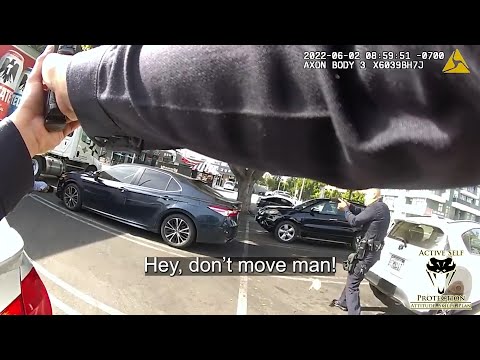
Instructor Mike, a firearms instructor, explains the physiological stress response during high-stress encounters, detailing how the amygdala overrides the prefrontal cortex. He emphasizes the importance of stopping and calming down to allow rational thought to return, benefiting both civilians and law enforcement during critical interactions.
This video analyzes an LAPD officer-involved shooting incident, highlighting the use of POM Pepper Spray and the Axon Body 3 bodycam. Experts John Correia and Mike Willever discuss the tactical response, legal justifications under Tennessee v. Garner, and the impact of stress on memory and perception during high-stress events.
Instructor Mike, a professional firearms instructor, demonstrates the vulnerability of open-carry holsters, specifically the Blackhawk CQC Level 2. Through a live demonstration, he shows how easily a firearm can be snatched by an attacker, especially when the carrier is distracted or physically manipulated. The instructor emphasizes that physiological responses to stress and physical contact can override a person's ability to protect their weapon, urging viewers to prioritize secure gear for open carry.
This video explains auditory exclusion, a physiological response to adrenaline dumps during high-stress events like a gunfight. John Lovell details how the body prioritizes survival, leading to narrowed vision and reduced hearing, impacting fine motor skills. The discussion also touches on self-defense tactics, emphasizing the importance of understanding legal, moral, and tactical considerations, and advising against unnecessary confrontation.
This segment details the 'ball and dummy' drill for revolvers, designed to improve trigger control by highlighting the shooter's tendency to dip the muzzle when anticipating an empty chamber. By making the shooter aware of this physiological response and motivating them to correct it, significant improvements in shot grouping can be achieved, as demonstrated by the speaker's experience with a new shooter.
This video highlights the MILO training system's immersive approach to firearms skill development. It emphasizes creating realistic stress scenarios to build muscle memory, reaction time, and accuracy. The system uses physiological monitoring and detailed debriefing to help trainees understand and overcome stress-induced phenomena like auditory exclusion and tunnel vision, fostering instantaneous learning and self-improvement.
This episode of NRA Women's "Tips & Tactics," presented by Smith & Wesson and sponsored by Cabela's Outdoor Fund, features Applied Firearms Defense Skills instructors Cat and Whitney Potgeter discussing the physiological and psychological responses to a life-threatening encounter. They explain how these reactions can impact self-protection capabilities and emphasize the importance of training that simulates real-life scenarios to enhance survival determination. The video encourages viewers to persevere and prevail in confrontations.
You've reached the end! 7 videos loaded.
Gun Laws by State
Read firearms regulations for all 50 states + D.C.
Find Gun Dealers
Search licensed FFL dealers near you.