This guide details the installation of Slick Shot stainless steel nipples on a Pietta 1860 black powder revolver. The upgrade aims to improve reliability by preventing cap fragments from jamming the cylinder and potentially enhancing ignition consistency due to a larger internal passage. The process involves unscrewing old nipples and installing the new ones, with a specific note on using Remington #10 caps.
This guide details a comparison between using an ultrasonic cleaner and a dishwasher for cleaning a black powder revolver. The experiment, conducted by an experienced shooter with 20 years of black powder experience, found the ultrasonic cleaner to be effective, while the dishwasher method resulted in light rust and bluing loss. The speaker strongly recommends the ultrasonic cleaner for firearm maintenance.
This video demonstrates the use of a turn-of-the-century black powder flask for volumetric powder measurement, highlighting its application for black powder firearms where precise volume is crucial. It contrasts this with modern automated dispensers and discusses the importance of volumetric measurement for black powder due to variations in density between different powder types and manufacturers. The guide details the operation of the flask for dispensing consistent charges.
This expert-level guide details destructive testing of a .50 caliber muzzleloader, specifically the Thompson/Center Encore Pro Hunter FX with Hornady Bore Driver bullets. The video demonstrates impressive terminal performance through ballistic gelatin, ceramic plates, pork shoulder with bone, and watermelons, showcasing the power and effectiveness of modern muzzleloader technology for hunting large game. The instructor, an expert with extensive hunting experience, provides authoritative insights into projectile performance and energy transfer.
This guide details the process of loading and firing the Pietta 1851 U.S. Marshall .44, a black powder revolver. Expert instruction covers preparing Pyrodex pellets, seating round balls, applying percussion caps, and safe live-fire demonstration at an outdoor range. The video emphasizes correct black powder loading procedures and safe firearm handling.
This video tests the viability of 21-year-old Pyrodex Select powder in an 1860 Army revolver. The experiment demonstrates that while the powder can still ignite after two decades, it exhibits significant hangfires, indicating a degradation in performance. The instructor advises against storing and using such old powder, emphasizing that its efficacy diminishes over time.
This video, titled "OLD Pyrodex!", appears to be a content piece focused on Pyrodex, a type of black powder substitute commonly used in muzzleloading firearms. While the description is currently pending, the title strongly suggests a discussion, review, or demonstration related to this historical propellant. Viewers can likely expect information on its properties, usage, or perhaps historical context within firearms.
This video, titled 'Black Powder vs. Pyrodex', aims to compare and contrast traditional black powder with the modern propellant Pyrodex. While the description is pending, the title clearly indicates a comparative analysis of different firearm propellants, likely focusing on their performance, characteristics, and potential applications in historical or muzzleloading firearms.
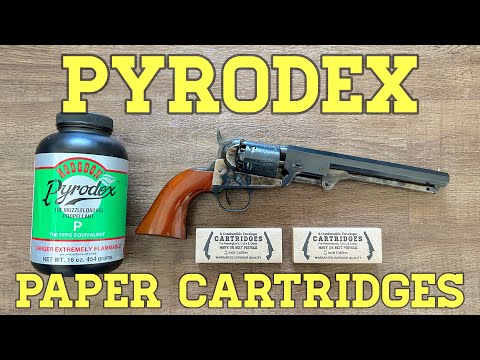
This video focuses on Pyrodex paper cartridges specifically for cap and ball revolvers. While a detailed description is pending, the title indicates a practical guide or demonstration related to using this type of ammunition for historical firearms.
This guide details how to create and safely fire blank ammunition for cap and ball revolvers using a specialized kit. It covers loading gunpowder and floral foam wads, emphasizing safety precautions like preventing chain fires and proper muzzle discipline. The process is demonstrated on an 1860 Army revolver, with advice applicable to other calibers and models.
This guide provides essential maintenance and safety information for the 1873 Springfield Trapdoor rifle, drawing on expert insights from a firearms instructor. It covers proper cleaning after shooting corrosive ammunition, inspecting historical markings, and critically, emphasizes the extreme importance of using only 'Trapdoor Safe' ammunition to prevent dangerous over-pressurization. Collectors and shooters will find actionable advice for preserving and safely operating this historic firearm.
This video explores the feasibility of reloading .22LR ammunition using a specialized kit from 22 Sharpshooter. While technically possible, the process is presented as complex and time-consuming, requiring additional reloading equipment. The instructor demonstrates using the kit with both smokeless (Unique) and black powder substitute (Pyrodex) propellants, noting that black powder substitutes yielded more consistent, albeit lower-powered, results. Ultimately, the video concludes that the effort and cost involved make reloading .22LR impractical compared to purchasing factory ammunition.
Gun Laws by State
Read firearms regulations for all 50 states + D.C.
Find Gun Dealers
Search licensed FFL dealers near you.