This video explores the declining popularity of Low Power Variable Optics (LPVOs), detailing their initial appeal as all-in-one solutions for both close and distant engagements. It highlights key drawbacks including added weight, reduced speed at close range compared to red dots, potential eye fatigue, and the practical consideration of whether their magnification is truly necessary for an individual's typical shooting environment. The speaker suggests offset red dots as a potential alternative for certain use cases.
This review from Regular Guy Training LLC offers a highly critical assessment of the Griffin Armament ICO 1-8 LPVO. The instructor, drawing on extensive experience, found the optic to be 'utterly unworthy' due to severe performance issues at both 1x and 8x magnification. Key criticisms include a microscopic eye box, poor reticle visibility, low-quality glass, ineffective illumination, and problematic eye relief, making it a liability rather than a useful tool.
This video emphasizes that 'budget' in firearms and gear acquisition means planned saving, not simply buying the cheapest option. The speaker, a firearms instructor, advises against impulse buys driven by sales and emotions, advocating for analytical thinking and prioritizing essential features like optic clarity and reticle design. The core message is to invest wisely, save for better equipment when necessary, and understand that your skill level, not product tier, defines your proficiency.
This review covers the Vector Optics Sentinel 10-40x50 scope, highlighting its suitability for airgun and .22LR precision shooting, but also its capability on centerfire rifles up to .308 recoil. The reviewer demonstrates its use on a 5.56 rifle, focusing on its close-range parallax capabilities and fine reticle dot. It also details the included scope rings and the option of 20 MOA canted rings for specific rifle setups.
This discussion from Gunwerks' Longrange Pursuit podcast delves into the critical differences between First Focal Plane (FFP) and Second Focal Plane (SFP) rifle scope reticles, emphasizing their impact on long-range hunting. The experts highlight how FFP reticles maintain accurate subtensions across all magnifications, simplifying shot execution under pressure, while SFP reticles require specific magnification settings for accuracy. They also discuss reticle design considerations for hunting, including low-light visibility and intuitive aiming points, with a focus on the Revik RH2 reticle.
This video features an in-depth interview with professional PRS shooter Brandon Rudge, discussing the design and features of the March FX PRS Edition scope. Rudge explains the rationale behind key design choices, including reticle thickness, turret functionality, and the removal of illumination, all tailored for competitive Precision Rifle Series shooting. The discussion highlights the importance of practical features over aesthetic trends like 'Christmas tree' reticles in modern PRS.
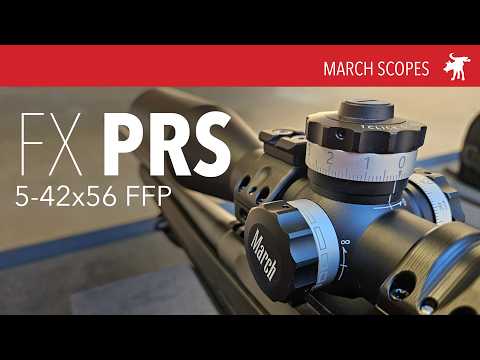
This video provides an in-depth review of the March FX 5-42x56 PRS Edition scope, highlighting its design for Precision Rifle Series (PRS) competitions. It details the scope's high magnification range, large objective lens, robust 34mm tube, and unique features like writable turrets and a precise zero stop. The review also discusses the reticle design and optical performance at various magnifications, offering insights for competitive shooters.
This video from 9-Hole Reviews discusses critical reticle considerations for precision carbine optics, focusing on mid-range engagements. It highlights three key functional elements: refined aiming solutions, fast and repeatable target reacquisition through recoil, and the ability to self-spot impacts. The discussion uses the Nightforce NX8 with Mil-XT and Leupold Mark 5 with PR2 reticles as comparative examples, emphasizing user preference in final selection.
This video emphasizes that the effectiveness of an LPVO is heavily dependent on the shooter's skill and proper setup, not just the optic itself. It details how to optimize the eyebox by setting the optic for maximum magnification and discusses how mount height and stock length of pull should be adjusted based on whether the focus is close-quarters, long-range, or a balance of both. The instructor highlights the importance of understanding ballistics, atmospherics, and managing magnification and 'dope' (data on previous engagements) to fully utilize an LPVO's dual-discipline capabilities.
This video addresses common misunderstandings surrounding the EOTech EXPS3 optic, aiming to clarify its intended use and features. The instructor highlights that many online reviews lack a deep understanding of the optic's design and purpose, leading to inaccurate criticisms regarding battery life and reticle clarity. The content suggests the EXPS3 may possess one of the best offensive reticles available, considering its feature set.
This video compares the Vortex Venom 1-6x and Primary Arms Nova 1-6x budget LPVOs, highlighting their strengths and weaknesses. The Vortex Venom offers better glass clarity at higher magnifications and a more refined external build with superior turrets. The Primary Arms Nova excels in daylight reticle brightness and a more intuitive 1x field of view, making it ideal for run-and-gun scenarios. Pricing is a key differentiator, with the Venom being cheaper.
Gun Laws by State
Read firearms regulations for all 50 states + D.C.
Find Gun Dealers
Search licensed FFL dealers near you.