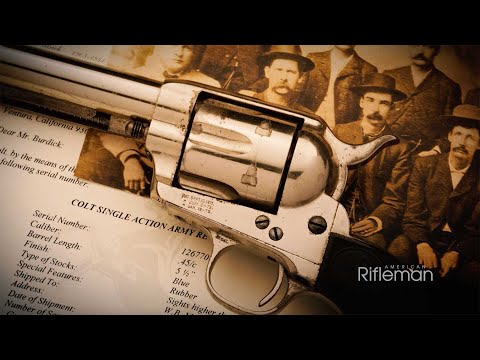
This video explores the 150-year history and enduring appeal of the Colt Single Action Army (SAA) revolver, also known as the Peacemaker. It details its development in 1873, influenced by the expiration of the Rollin White patent, and its subsequent adoption by the U.S. military. The SAA's iconic design, reliability, and chambering in powerful cartridges like the .45 Colt are highlighted, along with its cultural impact through film and television, leading to its continued production through various generations.
This guide details the unique side-loading operation of the rare 1863 Slocum Side-Loading Revolver. The video, presented by Caleb Savant and Cody Slocum, highlights the innovative mechanism designed to bypass the Rollin White patent. Cody Slocum, with a family connection to the inventor, provides expert insight into the firearm's history and mechanical function.
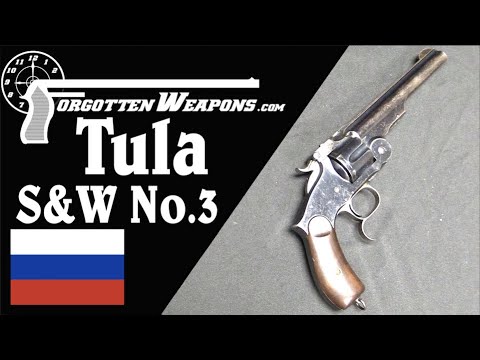
This video provides an in-depth look at the Smith & Wesson No.3 Russian Model revolver, specifically those produced at the Tula Arsenal in Russia. It covers the historical context, design evolution, technical specifications, and unique markings of these firearms, highlighting their significance in Russian military history and their advantages over contemporary revolvers. The presentation by Ian McCollum offers expert analysis on the firearm's mechanics and historical impact.
This video provides an expert-level look at a rare Winchester Swing-Out Cylinder Revolver from the 1870s, presented by firearms historian Keith Ford. The demonstration highlights its unique right-side swing-out cylinder, superior mechanics compared to the Colt SAA, and historical context, including patent agreements of the era. It's noted as one of only four known examples with this feature.
This video provides an expert-level overview of the Rollin White Arms Co. Revolver, focusing on its historical significance and mechanical details. Ian McCollum of Forgotten Weapons details the revolver's unique features, including its solid frame, sheath trigger, and the crucial Rollin White patent for bored-through cylinders. The guide covers basic disassembly for cylinder removal and offers insights into the internal workings, highlighting its construction for Smith & Wesson.
This entry details the mechanical operation of the Smith & Wesson No. 3 Russian revolver, focusing on its top-break action, single-action mechanism, and automatic ejection system as shown in a 3D animation. It also touches upon the historical context of its development, including the crucial Rollin White patent and the evolution of Russian variants. The information is presented with a high degree of technical detail, reflecting the channel's recognized authority on historical firearms.
This guide details the basic disassembly of the Pond .32 Rimfire Revolver, focusing on accessing its integrated tool and highlighting critical safety concerns. Expert Ian McCollum demonstrates how to remove the threaded screwdriver from the grip. A key takeaway is the firearm's lack of a half-cock notch, a significant safety deficiency that requires careful handling.
This guide details the impractical cylinder removal process for the James Reid No. 2 Revolver, a 7-shot, .32 proprietary rimfire single-action revolver from the Civil War era. The video highlights a significant design flaw where the barrel must be partially unthreaded to free the cylinder for cleaning, a process requiring careful handling and specific tools. Expert analysis from Ian McCollum underscores the historical context of patent disputes and unique manufacturing methods of the period.
This guide details the unique loading and maintenance procedures for the Slocum Revolver, as explained by Ian McCollum on Forgotten Weapons. It covers the innovative sliding chamber mechanism for loading and unloading, safety features like notches between chambers, and basic maintenance access. The Slocum Revolver is a 5-shot, .32 Rimfire, single-action firearm with a brass frame, notable for its design circumventing the Rollin White patent.
This guide details the disassembly and safety features of the rare Thuer Conversion Colt 1849 Pocket Revolver. Expert Ian McCollum explains the unique front-loading cartridge system designed to bypass Rollin White's patent. Key features include a specialized backing ring with a firing pin and a safety 'snap cap' position, allowing for safe carrying of a loaded revolver. The conversion's design allows for easy reversion to percussion.
You've reached the end! 10 videos loaded.
Gun Laws by State
Read firearms regulations for all 50 states + D.C.
Find Gun Dealers
Search licensed FFL dealers near you.