This content explores the advanced safety features of TRISO fuel used in micro-reactors and SMRs. It highlights TRISO's durability, comparable to tank armor, and its passive cooling systems, making it 'walkaway safe.' The discussion touches on significant government R&D investment in these next-generation nuclear technologies.
This video explores a viral laser experiment where viewers perceive complex patterns resembling alien code or Japanese characters at the laser's point of contact. The phenomenon is consistent and stationary relative to the wall, even when the observer moves. An engineering explanation is suggested, pointing to a physical optical effect rather than a hallucination.
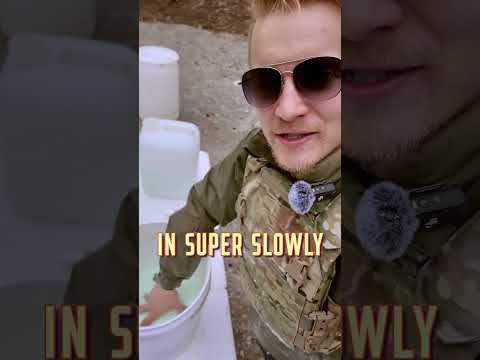
This video explores the ballistic capabilities of liters of liquid, specifically how much volume is needed to stop a bullet. It delves into the physics of projectile impact and material resistance, likely using various materials or scenarios to demonstrate the effectiveness of liquid barriers against different types of ammunition. The video aims to provide an understanding of kinetic energy transfer and the properties that make certain substances effective at absorbing or deflecting bullets.
This YouTube video features a modern pirate experiment testing the effectiveness of chain shot fired from a shotgun. The experiment aims to determine if this historical tactic still works today by firing different types of chains at targets like pineapples and ballistic gel. The video delves into the history and mechanics of chain shot, showcases the preparation of shotgun cartridges with chains, and presents the results of tests on various media. It concludes with the findings of the experiment.
This experiment tests bullet deflection and glass behavior when shooting through a car window. The first 9mm shot from a Girsan Witness Match X 2011 deflected about an inch downward, with the tempered glass shattering but remaining in place. Visibility is severely impaired after the first shot, making subsequent aimed shots difficult.
This YouTube video title, "Será que essa é a bazuca de batata mais insana que existe?" (Is this the most insane potato bazooka that exists?), suggests a focus on a homemade, high-powered projectile launcher, likely a potato cannon. The term 'bazuca' implies a significant and powerful device. While not a conventional firearm, the construction and potential destructive capability align with DIY weaponry and projectile launchers, which can attract an audience interested in experimental engineering, physics demonstrations, and potentially the boundaries of what can be considered a 'weapon' or launch device. The content is likely to be entertaining and demonstrate a unique build.
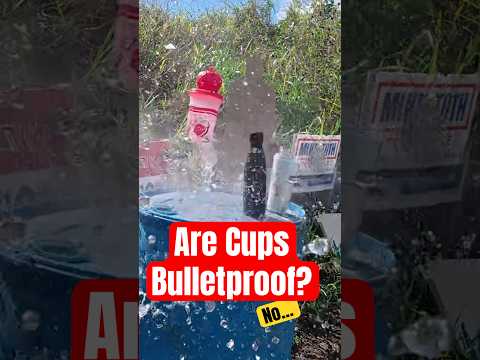
This YouTube Short title poses the question "Are Cups Bulletproof?" with a dramatic emoji, suggesting a test or demonstration involving cups and potentially firearms, although no specific firearms or calibers are mentioned in the title or description. The content likely aims to be sensational or educational by testing the ballistic resistance of everyday objects.
This experiment tests the ability of dry ice to stop various bullet calibers, from .22 LR to a 20mm Vulcan round. While smaller calibers shatter the dry ice, larger rounds like the .460 Magnum and 12-gauge slug obliterate it. The 20mm round, despite immense energy, penetrates most of the dry ice blocks but is ultimately stopped. The video highlights dry ice's surprising resilience against projectile impacts.
This experiment tests the bullet-stopping capabilities of Oobleck, a non-Newtonian fluid, against various calibers. While Oobleck successfully stopped .22 LR and .380 ACP rounds, it was penetrated by .45 ACP and .223 Rem. A .50 BMG round completely destroyed the setup, including the Oobleck container and table, and passed through the mannequin.
This video tests the bulletproof capabilities of Oobleck, a non-Newtonian fluid, against various firearm calibers. While Oobleck successfully stopped .22 LR, .380 ACP, and .223 rounds, it was penetrated by .45 ACP and catastrophically failed against a .50 BMG. The experiment also demonstrated Oobleck's effectiveness against blunt force but its vulnerability to sustained pressure.
This video, titled "Moeda de 1 centavo: Quanto perigo ela esconde? (Teste)" (1 cent coin: How much danger does it hide? (Test)), appears to be a test or demonstration involving a 1-cent coin and its potential dangers. While the title suggests a physical test, the description does not provide further details. Without a transcript or more descriptive content, it's difficult to ascertain the exact nature of the 'danger' or if it relates to firearms in any way. The content seems to focus on a common object and a 'test' scenario.
This experiment tests if a powerful 1500kg magnet can catch a 9mm bullet. Standard bullets are non-ferrous, so magnetic ammunition was used. Despite the strong magnet, the bullet's velocity was too high for it to be caught, demonstrating the limitations of magnetism against kinetic energy.
Gun Laws by State
Read firearms regulations for all 50 states + D.C.
Find Gun Dealers
Search licensed FFL dealers near you.