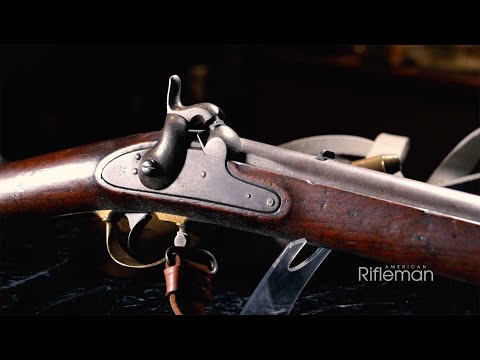
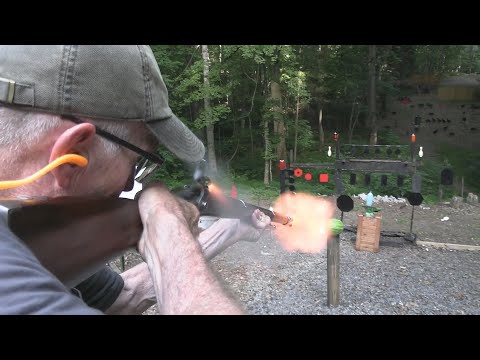
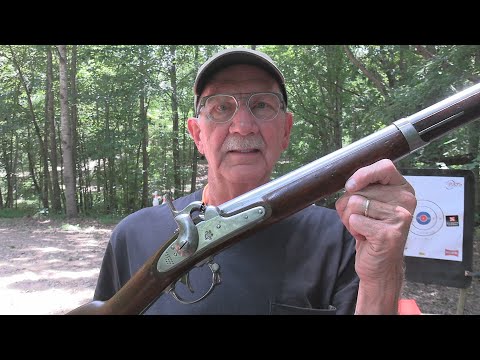
This video provides a historical overview of the smoothbore musket era in the U.S. Army, from its origins in the Revolutionary War through the Civil War. It details the evolution of muskets, including the adoption of French designs, the development of American manufacturing capabilities with interchangeable parts, and the transition from flintlock to percussion ignition. Expert insights from NRA Publications and museum curators highlight key models and their significance.
This video provides an expert-level analysis of the lethality of military flintlock firearms, featuring demonstrations by Administrative Results and Austin from Vintage Warfare. The content delves into the ballistics and historical context of weapons like the Brown Bess, Baker Rifle, and Ferguson Rifle, comparing their effectiveness to modern firearms. The presenter's high authority and specialized knowledge in historical firearm demonstrations are evident throughout.
This video explores the historical significance of the Harper's Ferry 1842 smoothbore musket, emphasizing its role in American history and its technical features. It demonstrates the loading process for both a standard ball and a 'buck and ball' load, highlighting the musket's effectiveness even through the Civil War. The presenter encourages viewers to develop a greater appreciation for history beyond modern firearms.
This video provides a detailed look at the Model 1841 rifle, often called the Mississippi rifle. It highlights its transition from flintlock muskets to percussion priming, its role as a 'rifleman's rifle' for skirmishing, and its distinctive features like the brass patch box. The discussion covers its caliber evolution and its historical significance in the Mexican-American War.
This guide details techniques for participating in N-SSA smoothbore musket competitions, emphasizing historical authenticity and safe shooting practices. Instruction draws from experts within the historical firearms community, covering ammunition, target engagement, and the specific firearms commonly used, such as the Model 1842 and Macon Conversion. The focus is on preserving history through competitive shooting.
This video provides a continuation of the review of the Harper's Ferry Model 1842 Musket, focusing on its historical significance as the last general-issue smoothbore and first general-issue percussion military firearm in the US. The presenter demonstrates firing the musket with round balls and buck and ball loads, discussing its .69 caliber and the nuances of loading and shooting, particularly the surprising effectiveness of buckshot placed on top of the main ball for tighter groups. The video also touches on the historical context of Harper's Ferry and the transition from flintlock to percussion ignition.
This video demonstrates the 'Mad Minute' speed loading technique for a smoothbore musket, as performed by Karl Kasarda on InRangeTV. The expert-level instruction focuses on the efficient manual of arms required for flintlock ignition and historical paper cartridge loading. Kasarda consistently achieves accuracy under time pressure, showcasing a high level of proficiency in this challenging drill.
This video demonstrates the historical reloading and firing process for a 1770s Charleville flintlock musket, modified into a carbine. It details the use of paper cartridges, priming the pan, loading the powder and ball, and the challenges of rapid firing without modern sights. The demonstration highlights the difficulty of achieving multiple hits in a minute with such a firearm.
This video features a detailed look at the 1842 Harper's Ferry smoothbore musket, including its historical significance and shooting performance. The host shares insights from a trip to historical sites like Harper's Ferry and Gettysburg, discussing the firearms used in those eras. The content emphasizes the historical context of firearms and their role in American history.
This guide details the process of loading and firing the Harper's Ferry Model 1842 .69 caliber smoothbore musket, including the use of round balls, 'Buck and Ball' loads, and its conversion to a 14-gauge shotgun. The instruction emphasizes historical accuracy and practical application, drawing from an expert's extensive experience with black powder firearms.
This video demonstrates the loading and firing process for a 69 caliber 1842 Harper's Ferry musket. It covers essential techniques such as proper powder charging, ball and patch seating, and the use of percussion caps. The presenter also discusses common issues like dry-balling and the importance of experimentation with ball and patch sizes for optimal performance. Additionally, it explores historical loads like buck and ball and converting the smoothbore musket into a shotgun.
This video provides an in-depth look at the French "snuff box" breech-loader, specifically the 1853/67 Tabatière rifle, presented by firearms expert Jonathan Ferguson of the Royal Armouries. It details the conversion process from the original 1853 smoothbore musket to a breech-loading system, highlighting its distinctive features, caliber, and comparison to contemporary firearms like the British Snyder and French Chassepot. The expert also discusses its historical context within the Franco-Prussian War and its logistical implications for the French military.
You've reached the end! 12 videos loaded.
Gun Laws by State
Read firearms regulations for all 50 states + D.C.
Find Gun Dealers
Search licensed FFL dealers near you.