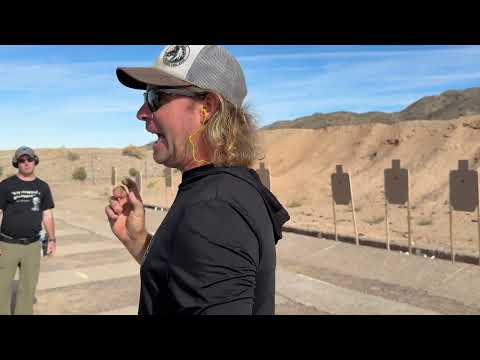
This video, featuring insights from Joel Park, addresses the common question of whether focusing on the entire A-zone is more efficient for fast shooting. Park argues against this 'loser mentality,' advocating for precise visual focus on the aiming point, even at speed. He demonstrates a drill comparing focused versus broad visual acquisition, highlighting that precise focus, while seemingly slower, leads to greater consistency and accountability. The video also provides actionable advice on using rules in dry fire to improve trigger control and reduce over-confirmation.
This video addresses common issues with target transitions during dry fire practice, identifying vision and tension as the primary culprits. Instructor Joel Park emphasizes looking at the target first and letting the sights follow, rather than physically pushing the gun. He advises against using excessive body tension and highlights the importance of visual focus on the target spot, not the sights, to improve accuracy and speed in transitions.
This guide, based on instruction from professional shooter Joel Park, addresses how practicing rapid-fire drills like 'doubles' can inadvertently harm performance in longer strings such as the 'Bill Drill'. It emphasizes the critical importance of maintaining consistent grip tension and hand pressure throughout the entire sequence. The guide also highlights common errors like 'dot staring' during extended fire and provides techniques to improve visual focus and target transitions through dry fire practice.
This guide details a productive handgun training day focused on close, fast shooting with a Walther PDP, emphasizing advanced techniques like 'snapping' eyes to targets and proper trigger control to avoid 'trigger freeze.' The session, led by Joel Park, highlights diagnostic training and organic methodology over rigid round counts, drawing from competition drills like El Prez.
This guide details a marksmanship drill from Ben Stoeger, focusing on fundamental shooting problems and recoil control. It emphasizes achieving tight groups through proper grip, visual focus, and mental cues, encouraging aggressive training to improve speed and accuracy at various distances. Instruction is provided by an expert with a professional competition background.
This guide focuses on a crucial shooting technique: maintaining eye focus and avoiding blinking during the shot cycle. Johnny Q, a professional shooter and content creator, demonstrates how to keep your eyes open while firing both pistols and rifles, even under rapid fire conditions. He emphasizes that this skill takes practice and encourages shooters to work through the natural reflex to blink, highlighting the importance of visual discipline for accuracy and control.
This video, titled 'At least it has tiger stripe' and with a similar description, appears to be a brief and minimalistic showcase of a firearm. The description heavily emphasizes a 'tiger stripe' pattern, suggesting a visual or aesthetic focus. The content is likely a quick look at a gun, potentially highlighting its unique finish. The creator encourages viewers to check out their Patreon, email newsletter, and other websites/affiliate links for more content and support.
This drill, demonstrated by Hwansik Kim, focuses on rapid target transitions and precise shot placement. The core principle is to exit the target as soon as the trigger breaks, snapping vision and the gun to the next point of aim. It emphasizes assessing the precision of the stop on the next target, identifying issues like swirling dots (poor vision focus/mobility) or sweeping motions (excessive shoulder tension).
This video demonstrates a three-target firearm transition drill focusing on efficient sight acquisition and target engagement. Instructor Matt emphasizes looking at the desired impact point rather than the sights, allowing the sights to naturally track to the target. This technique aims to improve speed and accuracy by minimizing unnecessary mechanical movements and maximizing visual focus on the task.
Joel Park advises against shooting by ear (cadence) when accuracy is paramount, advocating instead for shooting by vision. While cadence can be a useful training tool for drills like target transitions, he emphasizes that for score or critical situations, focusing on visual cues like sight alignment and target acquisition is far more effective. This approach ensures deliberate engagement rather than a potentially inaccurate, pre-programmed rhythm.
This video details Professor Hwansik Kim's 'One Shot Return Drill,' designed to improve the speed and precision of a shooter's sight recovery after firing a single shot. The drill emphasizes maintaining target focus on a small spot, achieving a fast and thin red dot streak during recoil, and ensuring the red dot returns precisely to the aiming point. It addresses common issues like lack of urgency, poor visual focus, and muscle tension, offering guidance on proper body mechanics and vision.
Former CIA Officer Jason Hansen outlines a multiple threat engagement drill designed for home invasion scenarios. The drill emphasizes leading with the eyes, prioritizing the most dangerous threat, and transitioning between targets. It incorporates a 6-inch steel plate to simulate a smaller, further threat and stresses the importance of adjusting engagement speed and performing tactical reloads.
Gun Laws by State
Read firearms regulations for all 50 states + D.C.
Find Gun Dealers
Search licensed FFL dealers near you.