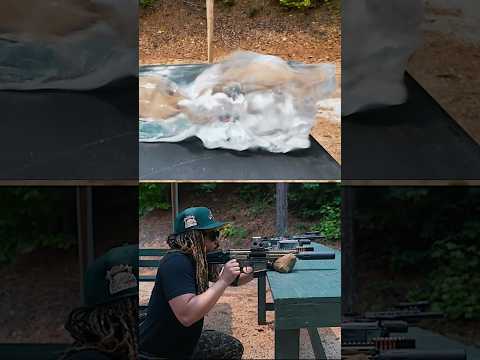
This video demonstrates the terminal ballistics of 338 ARC supersonic ammunition fired into a ballistic gel block. The test reveals a significant wound channel, with the bullet appearing to tumble and deviate, ultimately stopping within the gel. The performance is contrasted with a previous 300 Blackout supersonic shot that penetrated completely through the block.
This video demonstrates the performance of Pilgrim Ammunition through ballistic gel tests and recoil comparison against Hornady Critical Defense. The tests highlight Pilgrim's high velocity (2000 ft/s), light 50-grain weight, and unique 'exploding' expansion pattern resulting in zero over-penetration. It also showcases significantly reduced recoil and improved control during rapid fire drills, making it a top choice for daily carry.
This video demonstrates the critical difference between full metal jacket (FMJ) and high-quality hollow point (HP) defensive ammunition using ballistic gel. Caleb from Brownells shows that while FMJ creates a narrow wound channel and passes through, HP ammunition is designed to expand, creating a larger wound channel and potentially stopping within the target, which is crucial for effective self-defense.
This video demonstrates a ballistic gel test designed to evaluate the effectiveness of different rifle cartridges and bullet types in hunting scenarios. By simulating obstructions like 'punch' and 'bone' and measuring penetration and wound channel characteristics, the experiment aims to prove that cartridge choice significantly impacts terminal ballistics, contradicting the notion that 'caliber doesn't matter'. The findings highlight differences in performance between calibers like the .243 Winchester, 6.5 Creedmoor, .270 Winchester, 7 PRC, and .300 Win Mag.
This expert-level review from Tools&Targets pits two heavyweight 9mm defensive rounds, Federal Premium HST 147gr and Winchester Ranger T-Series 147gr, against each other. Tested with a P80 pistol and a heavy clothing barrier, both rounds demonstrated exceptional performance in ballistic gel, with near-identical velocities and penetration. The analysis highlights subtle differences in expansion and material shedding, concluding both are top-tier choices.
This video details a ballistic gel test comparing Federal Premium HST 124 grain and Federal Punch 124 grain 9mm ammunition fired through a heavy clothing barrier. The test utilizes a Taurus GX4 with a 3-inch barrel and measures velocity, penetration, and projectile expansion. The HST demonstrated superior expansion and a more significant wound channel compared to the Punch, though both rounds performed adequately.
This video presents a ballistic gel test comparing Fort Scott Ammunition's 9mm Tumble Upon Impact rounds against standard Browning 115-grain Full Metal Jacket (FMJ) ammunition, fired from a Canik TP9SFx. The test aimed to evaluate the tumbling and wound channel characteristics of each round. While the Tumble Upon Impact rounds did tumble and create a significant wound channel, the presenter found the performance to be comparable to the FMJ rounds, which also exhibited tumbling and created a substantial wound channel, albeit with greater penetration. The presenter questions the cost-benefit of the specialized ammunition.
This video details a ballistic gel test comparing Black Hills Honey Badger and Inceptor ARX .380 ACP ammunition fired from an S&W M&P Shield EZ. It provides chronograph data for both rounds, noting the Honey Badger averaged 1179 FPS and the ARX averaged 1232 FPS. Both projectiles achieved 12.5 inches of penetration in gel, with the ARX tumbling and rebounding slightly, while the Honey Badger did not tumble. No deformation or expansion was observed on either solid projectile.
This video details a ballistic gel test of Fort Scott Munitions .45 ACP 180-grain Tumble Upon Impact ammunition, fired from a Rock Island 5-inch 1911 and a Colt 3.5-inch compact 1911. The test measures projectile velocity and observes tumbling behavior and penetration depth in ballistic gel, noting the solid copper construction and lack of deformation.
This video provides a detailed gel test comparison between Federal Premium Punch .22LR and Federal Game Shok .22LR ammunition, fired from a Heritage Barkeep revolver. The instructor highlights the impressive velocity achieved by the Punch rounds and their significantly superior penetration and wound channel compared to the Game Shok. The Federal Premium Punch is recommended as a top-tier .22LR option for personal defense.
This video provides an expert-level ballistics comparison between the 5.56x45mm and 5.45x39mm calibers, utilizing an AR-15 and an AK-74 platform respectively. The 1ShotTV host, demonstrating high authority and practical experience, details the terminal ballistics of each round through standardized gel testing, highlighting differences in bullet design and impact behavior. The analysis concludes both calibers are effective, with distinct wound channel characteristics.
This video demonstrates the terminal ballistics of 7.62x39mm incendiary ammunition fired from an AK-47 pattern rifle into Clear Ballistics gel blocks. The presenter, new to incendiary rounds, observes significant thermal effects and expanded wound channels, noting variations in performance between two shots. The second shot exhibited a larger wound channel and stopped within the gel, while the first penetrated both blocks.
Gun Laws by State
Read firearms regulations for all 50 states + D.C.
Find Gun Dealers
Search licensed FFL dealers near you.