BREAKING: Supreme Court Just Announced INSANE GUN CONTROL Law!

Published on May 14, 2025
Duration: 12:07

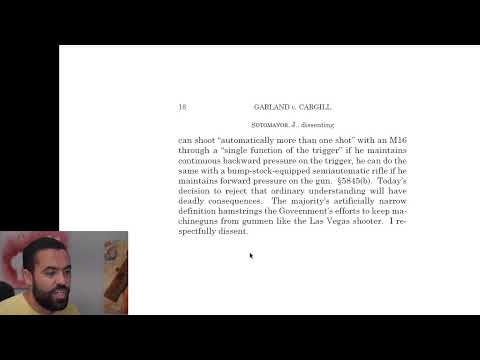
The Supreme Court case Garland v. Cargill examines the legality of bump stocks, devices that allow semi-automatic firearms to mimic fully automatic fire. The core legal question revolves around whether bump stocks alter the firearm's trigger mechanism to meet the definition of a machine gun under federal law. The discussion highlights the tension between statutory interpretation, congressional intent, and the evolving nature of firearm technology in the context of gun control.

Quick Summary

The Supreme Court case Garland v. Cargill addresses whether bump stocks, which enable semi-automatic firearms to mimic fully automatic fire by exploiting recoil, meet the federal definition of a machine gun. This definition requires the firearm to fire multiple shots automatically with a single pull of the trigger.

Chapters

  1. 00:00Introduction to Bump Stock Ban
  2. 00:35Garland v. Cargill Case Overview
  3. 00:44Federal Definition of Machine Guns
  4. 00:53How Bump Stocks Function
  5. 01:04Origin of the Bump Stock Ban
  6. 01:21Key Legal Question: Trigger Function
  7. 01:57Justice Barrett's Inquiry
  8. 02:15Chief Justice Roberts' Skepticism
  9. 02:44Impact on ATF Regulations
  10. 03:01Technical Aspects of Bump Stocks
  11. 03:24Predicting the Supreme Court's Decision
  12. 03:44Broader Gun Control Debate
  13. 04:46Arguments for the Ban
  14. 05:08Arguments Against the Ban
  15. 05:37Guidance from Garland v. Vandertock
  16. 06:01Context of Gun Violence
  17. 06:22Implications for Gun Policy
  18. 06:47Redefining Firearms with Braces
  19. 07:01Interpreting Gun Control Laws Broadly
  20. 07:19Cargill v. Garland's Significance
  21. 07:50Legal Debate Nuances
  22. 08:33Bump Stock Mechanisms
  23. 09:03Volition and Manual Action
  24. 10:01Justice Sotomayor's Proposal
  25. 10:42Focus on Trigger Mechanism
  26. 11:12Barrett's Inquiry on Trigger Definition
  27. 11:42Conclusion: Evolving Technology

Frequently Asked Questions

What is the main legal issue in the Supreme Court case Garland v. Cargill concerning bump stocks?

The central legal issue in Garland v. Cargill is whether bump stocks, which allow semi-automatic firearms to fire rapidly by using recoil, meet the federal definition of a machine gun, specifically the 'single function of the trigger' clause.

How do bump stocks enable rapid firing without technically altering a firearm's internal mechanism?

Bump stocks leverage the firearm's recoil to create a rapid firing effect. The stock moves back and forth, 'bumping' the trigger against the shooter's stationary finger, allowing for multiple shots with a single continuous pull of the trigger.

What is the federal definition of a machine gun that is relevant to the bump stock ban?

Under federal law, a machine gun is defined as a firearm capable of firing multiple shots automatically with a single pull of the trigger. The debate hinges on whether bump stocks cause a firearm to meet this definition.

What historical event prompted the Trump administration to ban bump stocks?

The Trump administration implemented a ban on bump stocks following the tragic mass shooting in Las Vegas in 2017, where the perpetrator used such a device to inflict numerous casualties.

Related News

All News →

More 2nd Amendment & Law Videos You Might Like

More from Best Iron

View all →