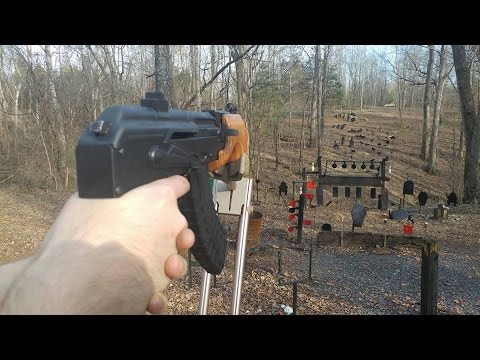
GCR #28 ATF issues and technology

Published on May 3, 2015
Duration: 74:55

This video discusses the legal complexities surrounding firearm classifications, specifically focusing on the ATF's interpretation of pistol braces and their reclassification of firearms. It highlights how administrative agencies, like the ATF, can issue letters that effectively change the legal status of firearms, creating a 'chilling effect' on manufacturers and owners due to the potential for severe penalties and the high cost of legal challenges. The discussion also touches upon the broader issues of legislative intent versus executive enforcement and the impact of legal ambiguity on the firearms industry and individual rights.

Quick Summary

The ATF's interpretation that shouldering a pistol with a brace reclassifies it as a Short Barreled Rifle (SBR) has created significant legal uncertainty. This 'chilling effect' deters manufacturers and owners from challenging potentially arbitrary rulings due to the high cost and risk of felony charges, highlighting the complex interplay between legislative intent and executive agency enforcement in firearm law.

Chapters

  1. 00:00Introduction & Sponsor
  2. 01:23ATF Issues & Firearm Classification
  3. 03:34Pistol Braces & Legal Loopholes
  4. 05:07ATF Letter & Reclassification
  5. 06:15Legal Opinion & Firearm Utility
  6. 07:34Law Updates & Bayonet Lugs
  7. 09:36Government Branches & ATF Power
  8. 11:09Enforcement & Legal Challenges
  9. 13:14ATF Effectiveness & Penalties
  10. 14:11Law vs. Usage & Government Incentives
  11. 15:13Ignorance in Legislation
  12. 17:16DUI Laws & Zero Tolerance
  13. 21:18Systemic Issues & Law Enforcement
  14. 29:17Getting Stuck in the System
  15. 30:02Highway Patrol Ads & Messaging
  16. 31:14Community Policing vs. Militarization
  17. 32:30History of Policing & Beat Cops
  18. 35:09Community Policing Success Stories
  19. 39:04The Thankless Job of Policing
  20. 41:04Police Recruitment & Mentality
  21. 42:18The Thin Blue Line Symbolism
  22. 43:59Messaging & Public Perception
  23. 44:27Law Firm Introduction (Sloan & Vck)
  24. 46:50Breaking Down Attorney Stereotypes
  25. 49:003D Printers & Future Technology
  26. 53:36Economic Impact of 3D Printing
  27. 56:513D Printers & Gun Rights
  28. 59:20Gun Control vs. Self-Defense
  29. 60:30International Gun Control Perspectives

Frequently Asked Questions

What is the ATF's stance on pistol braces?

The ATF's interpretation is that if a pistol equipped with a brace is shouldered, it is reclassified as a Short Barreled Rifle (SBR), requiring NFA registration and potentially leading to felony charges if not compliant. This interpretation has created significant legal uncertainty for firearm owners and manufacturers.

Why are ATF 'letter rulings' problematic for the firearms industry?

ATF 'letter rulings' can create a 'chilling effect' because they often lack the clarity of formal regulations and can change the legal status of firearms. Challenging these rulings in court is expensive and time-consuming, leading many to comply out of fear of severe penalties, even if they disagree with the interpretation.

How does the ATF's power compare to the legislative and judicial branches?

The ATF, as an executive branch agency, enforces laws passed by the legislature. However, their ability to issue interpretations and rulings can sometimes resemble judicial functions, giving them significant power in defining firearm legality without direct legislative or judicial oversight, which can be controversial.

What is the legal definition of a rifle according to the ATF?

According to the ATF, a firearm is classified as a rifle if it has a stock designed to be shouldered. This definition is crucial in determining whether a firearm with a barrel shorter than 16 inches is considered a Short Barreled Rifle (SBR) or a pistol.

Related News

All News →

More 2nd Amendment & Law Videos You Might Like

More from John Hickok

View all →