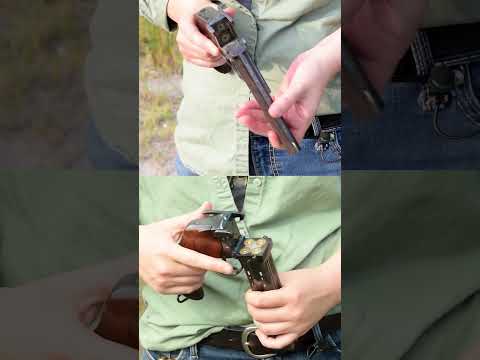
History Primer 188: British Lancaster Pistols Documentary

Published on November 14, 2023
Duration: 80:57

This documentary explores the history and mechanics of British Lancaster multi-barrel pistols, focusing on four-barrel and two-barrel configurations. It details their development from Howdah pistols, the innovative oval bore rifling by Charles Lancaster, and the complex internal mechanisms designed by Henry Thorne. The video contrasts these pistols with contemporary revolvers, discusses their limited production, and examines their reception and practical use.

Quick Summary

The British Lancaster pistol is a multi-barrel handgun, often featuring four barrels, known for its sealed action, rapid reloading, and easy-to-clean oval bore rifling. Its complex rotating firing pin mechanism strikes sequential chambers with each double-action trigger pull, though limited capacity and high cost restricted its widespread adoption.

Chapters

  1. 00:21Introduction to the Lancaster Pistol
  2. 00:36Specifications of the Four-Barrel Lancaster
  3. 02:23Historical Context: The Howdah Pistol
  4. 03:03Evolution to Military Use
  5. 04:04Enfield Revolver and Commercial Market
  6. 05:30Charles Lancaster and His Firm
  7. 06:09Lancaster's Oval Bore Rifling
  8. 07:02Henry Thorne and Multi-Barrel Patents
  9. 08:12Early Four-Barrel Pistols
  10. 08:41The More Common Four-Barrel Design
  11. 09:09Top-Break Mechanism and Extractor
  12. 11:13Firing Pin Assembly
  13. 11:37Demonstration with Dummy Cartridges
  14. 12:20Double-Action Trigger Mechanics
  15. 13:37Detailed Firing Pin Rotation
  16. 15:55Animation of the Mechanism
  17. 19:47Shooting the Lancaster Pistol
  18. 21:00Two-Barrel Lancaster Variations
  19. 21:31Cocking Trigger and Two-Barrel Mechanism
  20. 23:16Hands-On with the Two-Barrel Pistol
  21. 24:40Internal Differences: Fonu System
  22. 26:19Cocking Trigger Operation
  23. 29:45Animation of the Two-Barrel Mechanism
  24. 32:22Firing Pin Alternation in Two-Barrel
  25. 34:19Production and Serial Numbers
  26. 36:13Lancaster Pistol Configurations
  27. 38:29Reception and Service Use
  28. 41:16Advantages and Disadvantages
  29. 43:02Competitors and Market Demise
  30. 44:03May and Her Opinion on Lancaster Pistols
  31. 45:41Loading and Handling Impressions
  32. 51:08Trigger and Sight Impressions
  33. 54:23Recoil and Handling Experience
  34. 56:05Defensive Confidence Comparison
  35. 57:37Comparison with Enfield Mark I Revolver
  36. 63:29Comparison with Tranter 1879 Revolver
  37. 64:07Comparison with Webley Mark IV
  38. 66:49Two-Barrel Pistol as Target Pistol
  39. 67:44Initial Impressions of the Two-Barrel
  40. 68:44Cocking Trigger Operation

Frequently Asked Questions

What is a British Lancaster pistol?

A British Lancaster pistol is a type of multi-barrel handgun, most famously featuring four barrels, developed in the late 19th century. It evolved from the Howdah pistol and incorporated innovative features like oval bore rifling and complex rotating firing pin mechanisms.

What caliber did the Lancaster pistols use?

Lancaster pistols were chambered in various calibers depending on the model. Common calibers included the .476 Centerfire (Enfield Mark III cartridge) for four-barrel models and .577 for some larger two-barrel variants, with other options like .455 and .380 also available.

How did the Lancaster pistol's firing mechanism work?

The Lancaster pistol featured a unique rotating firing pin. With each double-action trigger pull, a mechanism would rotate the firing pin a quarter turn, aligning it with the next chamber, before the hammer struck the primer.

What were the main advantages of the Lancaster pistol?

Key advantages included its sealed action (preventing gas blowback), rapid reloading compared to some revolvers, and the ease of cleaning provided by its oval bore rifling. The multi-shot capability was also a significant feature.

Why were Lancaster pistols not widely adopted?

Despite their innovations, Lancaster pistols were expensive, had limited capacity (up to four shots), and faced competition from more practical revolvers and eventually autoloaders. Their complex mechanisms and ergonomic issues also contributed to their niche status.

More General Videos You Might Like

More from C&Rsenal

View all →