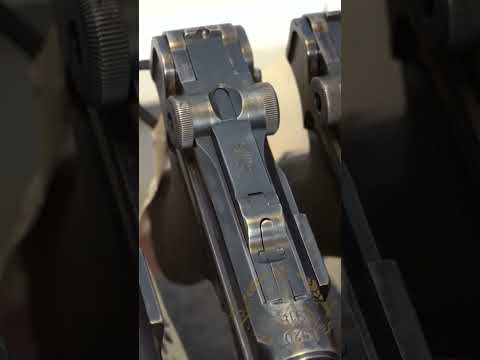
Is This The First US Military Test Luger?!

Published on April 26, 2023
Duration: 20:31

This video explores the history and potential significance of an early 1901 American Eagle Luger, believed by its owner to be one of the first two sent to the Springfield Armory for testing. It delves into the complexities of Luger trials in the US, distinguishing between commercial imports and military test samples, and examines unique markings like the American Eagle crest and 'US Property' stamps.

Quick Summary

Early US Military Test Lugers, like the 1901 models, are distinguished by an American Eagle crest on the receiver and often lack German proof marks. These were typically chambered in 7.65mm (.30 caliber) and sent to Springfield Armory for evaluation, though they were ultimately rejected due to insufficient caliber power.

Chapters

  1. 00:00Introduction: Early 1900s American Eagle Luger
  2. 00:21Luger Collector's Background & Early Luger History
  3. 01:11US Army's Search for Semi-Automatic Pistols (1898-1901)
  4. 01:33First Lugers Sent for US Testing (March 1901)
  5. 01:52The Thousand Test Lugers and Their Characteristics
  6. 02:41Importance of Country of Origin Markings
  7. 03:02Rejection of 30 Caliber Lugers & 9mm Trials
  8. 03:45US Army's Preference for .45 Caliber
  9. 03:56Disputed .45 Caliber Luger Trials (1907)
  10. 04:37Overview of Luger Categories Tested by the US
  11. 05:12The Mystery Gun's Place in History
  12. 05:32Analysis of the Featured 30 Caliber Luger
  13. 06:12Documentation of the First Two Test Guns
  14. 07:31The Germany Mark Debate on Early Test Lugers
  15. 08:52Examining the 'Ideal' Grips
  16. 09:59Springfield Proofs and Flaming Bombs
  17. 10:41Acquisition and Initial Inspection of the Gun
  18. 11:01Revealing Internal Markings: Serial Numbers & US Property
  19. 12:33The Controversy of Faked Markings
  20. 12:48NRA Museum Display and Expert Opinion
  21. 13:14Surprise Discovery of Internal Markings
  22. 13:45Forum Discussion and Historical Context
  23. 14:06Discovery of the Matching Ideal Stock (7 Years Later)
  24. 15:36The Ideal Stock's Markings and Condition
  25. 17:21Examining the Matching Magazine
  26. 17:54Assembling the Ideal Stock onto the Luger
  27. 19:05Functionality and Design of the Ideal Stock
  28. 19:50Conclusion: The Mystery Gun's Significance
  29. 20:24Call to Action: Like and Subscribe

Frequently Asked Questions

What are the key characteristics of early US Military Test Lugers?

Early US Military Test Lugers, particularly those from the 1901 trials, are often identified by an American Eagle crest on the receiver and typically lack the German 'N' proof mark. They were usually chambered in 7.65mm (.30 caliber) and were sent to Springfield Armory for evaluation.

Why were Lugers rejected by the US Army in the early 1900s?

The primary reason for the rejection of early Lugers by the US Army was the perceived inadequacy of the 7.65mm (.30 caliber) cartridge's power. The Army was accustomed to larger calibers like .45 ACP and sought a more potent round for their service pistol.

What is the significance of 'US Property' markings on a Luger?

'US Property' markings on a Luger, especially when accompanied by flaming bomb proofs and matching serial numbers on components, strongly indicate that the firearm was officially tested or acquired by the United States military or government agencies for evaluation or service.

What was the 'Ideal' grip and stock for Lugers?

The 'Ideal' grip and stock were accessories patented in 1901 by the Ideal Holster Company. While not widely adopted, they featured a unique telescoping mechanism for tightening and could function as both a shoulder stock and a belt holster for Luger pistols.

Related News

All News →

More General Videos You Might Like

More from Legacy Collectibles

View all →