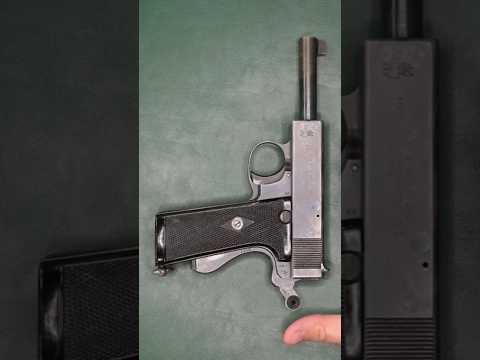
Why was this the last Webley pistol? With firearms expert, Jonathan Ferguson.

Published on January 25, 2023
Duration: 28:08

This guide details the disassembly of the Webley Jurek pistol, inspired by the Walther P38. It highlights the unique mainspring placement and the manual safety's lack of a decocking function. The information is presented by Jonathan Ferguson, Keeper of Firearms & Artillery at the Royal Armouries, emphasizing historical context and technical details.

Quick Summary

The Webley Jurek pistol, designed by Marian Karol Jurek, was inspired by the Walther P38 but featured unique innovations like its mainspring placement for a slim grip. Despite its design, it failed British military trials in 1953 due to poor performance in adverse conditions and complexity (79 parts), leading to the adoption of the Browning Hi-Power. Its manual safety also lacked a decocking function.

Chapters

  1. 00:00Introduction: Webley Jurek vs Walther P38
  2. 01:10Designer Background: Marian Karol Jurek
  3. 03:08Naming and Inscriptions: 'High Power' Meaning
  4. 04:22Caliber and Cartridge Details
  5. 05:40Design Evolution and Slide Features
  6. 08:06Safety Mechanisms and Flaws
  7. 10:46Internal Innovation: Mainspring Location
  8. 12:59Military Trials and Adoption Failure

Frequently Asked Questions

What made the Webley Jurek pistol unique in its design?

The Webley Jurek featured a unique mainspring placement within the hammer assembly, allowing for an exceptionally narrow grip. However, this innovation led to a very heavy 32lb double-action trigger pull, making precise aiming difficult for the first shot.

Why was the Webley Jurek ultimately not adopted by the British military?

During 1953 military trials, the Webley Jurek performed poorly in adverse conditions like sand and mud. It was also criticized for its complexity, having 79 parts compared to the Browning Hi-Power's 50 parts, leading to the adoption of the Hi-Power.

What was the significance of the 'High Power' inscription on the Webley Jurek?

The 'High Power' inscription on the Webley Jurek slide referred to the cartridge (CTG) rather than the model name. It denoted the use of the British 9mm Mark 2Z load, which was a more powerful variant developed to reliably operate submachine guns.

What safety features did the Webley Jurek possess, and what was a notable drawback?

The Webley Jurek included a manual safety and a magazine disconnect safety. A significant drawback was that the manual safety did not act as a decocker, which could potentially confuse users familiar with other pistol designs like the Walther P38.

More Gunsmithing & DIY Videos You Might Like

More from Royal Armouries

View all →