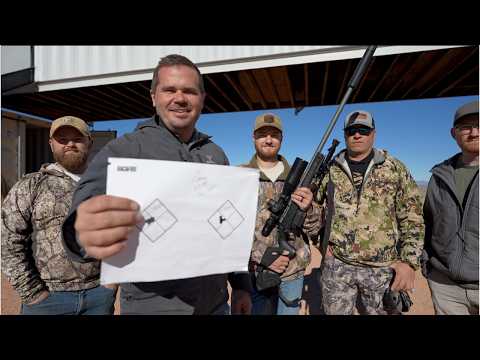
Paper Don't Lie | 1000 Yard Groups On Paper | Lessons Learned | Long Range Rifle Shooting

Published on January 14, 2021
Duration: 8:45

This video details a 1000-yard shooting session at the NRA Whittington Center, focusing on achieving tight groups on paper and understanding wind's impact. The instructor emphasizes trusting ballistic solvers like the Kestrel while also making real-time windage adjustments based on observed conditions, highlighting lessons learned from both successful shots and deviations.

Quick Summary

Achieving tight groups at 1000 yards requires precise windage adjustments. Trust your ballistic solver (like a Kestrel) for initial calculations, but actively observe environmental factors like mirage and wind. Failing to adjust for detected wind shifts can significantly impact your point of aim, as demonstrated by groups shifting high when wind was not corrected.

Chapters

  1. 00:01Introduction at NRA Whittington Center
  2. 00:51First 1000 Yard Group Attempt
  3. 02:07Assessing First 1000 Yard Group
  4. 03:57Second 1000 Yard Group Attempt
  5. 05:06Showing Second Group on Phone
  6. 06:12Lessons Learned: Obey the Kestrel
  7. 06:40Lesson: Believe the Bullet and Process
  8. 07:58Rifle Build Details
  9. 08:31Conclusion and Future Videos

Frequently Asked Questions

What are key considerations for shooting at 1000 yards?

For 1000-yard shooting, it's crucial to use a reliable ballistic solver like a Kestrel for accurate drop and windage calculations. Confirm your zero after significant elevation changes. Actively observe and adjust for wind conditions, as even slight shifts can drastically impact your point of aim.

How does elevation affect rifle zero at long range?

Higher elevations mean thinner air, which affects bullet trajectory. A rifle zeroed at sea level will likely shoot higher at 7,000 feet. It's essential to re-zero or use a ballistic solver that accounts for altitude to ensure accurate shots at long distances.

What is a good group size for 1000 yards?

Achieving a 10-round group of 5 inches at 1000 yards is considered excellent, equating to approximately 0.5 MOA. For most precision rifle applications, groups under 1 MOA are desirable, with sub-MOA groups being the standard for competitive long-range shooting.

How important is wind correction in 1000-yard shooting?

Wind correction is paramount at 1000 yards. Even a slight breeze can push a bullet many inches off target. Experienced shooters constantly monitor wind and mirage, making micro-adjustments to their hold or dialing their scope to compensate for its effects.

Related News

All News →

More Range & Competition Videos You Might Like

More from Precision Rifle Network

View all →