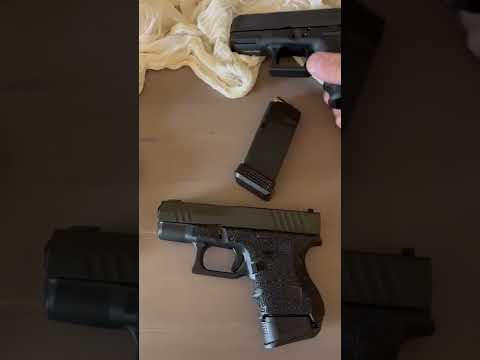
.357 Sig: Shield vs Glock 33

Published on November 7, 2024
Duration: 9:51

This comparison evaluates the .357 Sig caliber in compact handguns, specifically the M&P Shield and Glock 33, for concealed carry and self-defense. It highlights the .357 Sig's superior penetration and energy in short barrels, while addressing the trade-off of higher ammunition cost. Practical advice is offered on training with .40 S&W and using conversion barrels to mitigate expenses.

Quick Summary

The .357 Sig caliber offers superior penetration and energy in short-barreled handguns, consistently delivering over 500 ft-lbs of energy. While its main drawback is ammunition cost, training with a .40 S&W and using a .357 Sig conversion barrel is a practical way to mitigate expenses.

Chapters

  1. 00:00Introduction: .357 Sig Handgun Comparison
  2. 00:07M&P Shield with .357 Sig Conversion
  3. 00:31Explanation of .357 Sig Ballistics
  4. 01:12.357 Sig Cost and Training Advice
  5. 01:46M&P Shield vs. Glock 33 for Concealed Carry
  6. 02:27M&P Shield Specifications and Capacity
  7. 03:27Glock 33 Specifications and Capacity
  8. 04:10Dimensional Comparison and Concealment
  9. 04:42Trigger and Ergonomics Comparison
  10. 05:33Shootability and Magazine Compatibility
  11. 06:18.357 Sig Power in Short Barrels for Self-Defense
  12. 07:34Real-World Incident: .40 S&W vs. .357 Sig Stopping Power
  13. 08:27Benefits of .357 Sig and Practical Barrel Swapping
  14. 09:19Glock 39 in .45 GAP: Another High-Energy Option

Frequently Asked Questions

What are the key differences between the M&P Shield and Glock 33 for concealed carry?

The M&P Shield is generally thinner, making it easier to conceal, while the Glock 33 is shorter. Both offer effective .357 Sig performance, but the Shield's slim profile often gives it an edge for reducing printing.

How does .357 Sig ballistics compare to .40 S&W in short-barreled handguns?

.357 Sig, a bottleneck cartridge, uses a lighter projectile at higher velocity than .40 S&W. In short barrels, it consistently delivers over 500 ft-lbs of energy, offering superior penetration and incapacitation potential.

What is the main drawback of the .357 Sig caliber?

The primary disadvantage of .357 Sig is its ammunition cost. While prices can vary, it is often significantly more expensive than calibers like 9mm or .40 S&W, with store prices around $50 for 50 rounds.

How can I train with .357 Sig without incurring high ammunition costs?

A practical method is to train with a .40 S&W handgun that shares similar recoil characteristics, such as a Glock 27 or Shield 40. You can then swap to a .357 Sig barrel for defense purposes, mitigating training expenses.

Related News

All News →

More EDC & Lifestyle Videos You Might Like

More from SPN Firearms

View all →