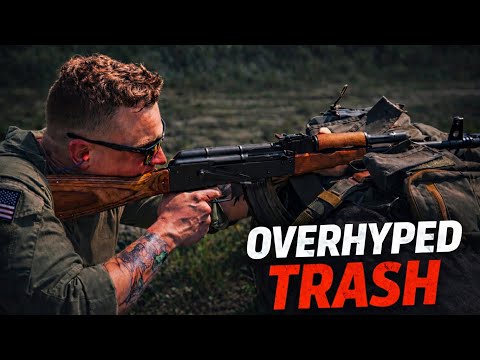
This video argues that the AK platform is an outdated and poor choice for new firearm owners in 2026, particularly in the United States. The presenter, Trench Grenade, cites higher ammunition costs for AK calibers (7.62x39mm and 5.45x39mm) compared to 5.56x45mm NATO, limited and often unreliable American AK market options, and significant disadvantages in modularity, accuracy, optics mounting, and suppressor compatibility when compared to the AR-15 platform. The presenter, drawing on personal experience and professional training, concludes that the AR-15 offers a more cost-effective, versatile, and user-friendly platform for most shooters.
This video provides a foundational comparison between cap and ball revolvers and metallic cartridge revolvers, detailing the loading process for each. It highlights the distinct steps involved in preparing and firing a cap and ball firearm, including powder, wads, balls, and percussion caps. The comparison then contrasts this with the simpler, self-contained nature of metallic cartridges, noting the potential cost and consistency differences.
This video compares 12, 20, and 410 gauge shotguns for turkey hunting, focusing on patterning, penetration in gel blocks, recoil, and cost per round using Federal TSS ammunition. The tests reveal that while all gauges can be effective at close range, the 12 gauge offers the most energy and penetration, the 20 gauge provides a balance of performance and reduced recoil, and the 410 offers a challenging, intimate hunting experience with sufficient pattern density for closer shots.
This roundtable livestream from Classic Firearms features experienced speakers Christopher W., Phillip K., Jonathan P., and Jacob W. discussing the merits of 5.56 versus 300BLK. They highlight 5.56's affordability and versatility for general use and training, contrasting it with 300BLK's specialized role, particularly for suppressed home defense. The discussion covers optimal barrel lengths, terminal ballistics, suppressor performance, and market trends, offering practical insights for choosing between these popular rifle calibers.
This video from GUNBROS features an experienced speaker who argues that reloading ammunition is generally not cost-effective for most shooters, especially for common calibers like 9mm and .223 FMJ used for range shooting. He explains that mass production by companies like PMC, Magtech, and S&B offers unbeatable prices due to economies of scale. Reloading is presented as a viable option only for specialized needs such as wildcat cartridges or custom hunting rounds where precision and unique specifications are paramount.
This video breaks down the real costs of competitive shooting, differentiating between a basic starter setup and an advanced competitor's gear. It details the expenses for firearms, magazines, holsters, belts, protective equipment, and the recurring costs of match fees and ammunition. The instructor emphasizes that while initial investment can be significant, gear upgrades offer performance multipliers that enhance shooting capabilities.
This video from TheYankeeMarshal discusses the variability of range round counts, influenced by activity and ammunition cost. The speaker, an experienced shooter, notes that while quick checks might use few rounds, extensive testing can involve hundreds. Most sessions fall between 50-100 rounds due to expense. The .45 Colt's recoil is also mentioned as a factor influencing shooting tolerance.
This video provides an expert guide to the Ruger MKIV Lite .22LR pistol, focusing on its suppressed fun factor and training benefits. The host, demonstrating high authority and technical knowledge, highlights the low cost of .22LR ammunition, its effectiveness as a training tool for diagnosing shooter errors due to minimal recoil, and its accessibility for new shooters. The guide also covers the pistol's features, maintenance, and the sheer enjoyment of accurate, quiet shooting at extended distances.
The video discusses the rising cost of ammunition and the economic viability of reloading. It suggests that reloading may not offer significant cost savings due to increasing prices of components like primers and bullets. Furthermore, potential bans on lead ammunition could exacerbate shortages and drive prices even higher.
This video provides an expert comparison of several World War II firearms, focusing on the cost of ammunition for each. The host, demonstrating high authority and specific knowledge of firearm mechanics and market pricing, breaks down the cost per round for the M1 Carbine, M1 Garand, Mosin Nagant, 1911, and Luger P08. It's an informative guide for budget-conscious firearm enthusiasts looking to shoot historical pieces.
This video compares the cost of firing various World War II firearms with current ammunition prices. It highlights the M1 Carbine in .30 Carbine as an affordable option, followed by the Mosin Nagant and the 1911 pistol. The M1 Garand is noted for its higher ammunition cost, and the German Luger is identified as the cheapest to fire but with reliability concerns.
Gun Laws by State
Read firearms regulations for all 50 states + D.C.
Find Gun Dealers
Search licensed FFL dealers near you.