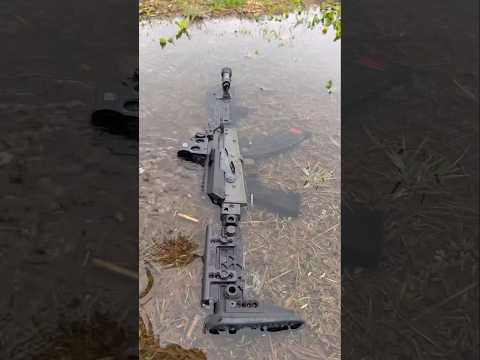
America’s Worst service rifle

Published on May 31, 2026
Duration: 12:05

This video provides a critical review of the M1A SOCOM 16 in a Sage EBR chassis, highlighting its historical context and practical shortcomings. While acknowledging its iconic look and appeal to collectors, the presenter emphasizes its significant weight, poor ergonomics, and questionable accuracy compared to modern alternatives like the AR-10. The review delves into the M14's development, its brief service life as a standard rifle, and its resurgence as a Designated Marksman Rifle (DMR) variant.

Quick Summary

The M1A SOCOM 16, often seen in a Sage EBR chassis, is a visually striking firearm popular with collectors but criticized for its heavy weight, poor ergonomics, and questionable accuracy compared to modern rifles like the AR-10. Originally designed for large-scale Cold War battles, its impracticality in Vietnam led to its short service life as a standard rifle.

Chapters

  1. 00:00Introduction: The M1A/M14
  2. 00:46Personal History with the M1A SOCOM 16
  3. 01:30Shooting Impressions: Gas and Recoil
  4. 02:14Silencer Shop Sponsorship
  5. 03:48History of the M14: From M1 Garand to Vietnam
  6. 09:47M14's Shortcomings in Vietnam
  7. 11:07The Rise of the M16
  8. 13:01M14's Return as a DMR
  9. 14:27M14 in Sage EBR Chassis: Aesthetics vs. Weight
  10. 16:41Accuracy and Reliability Issues
  11. 17:57Comparison to AR-10
  12. 18:27Conclusion and Outro

Frequently Asked Questions

Why is the M1A SOCOM 16 often criticized despite its cool appearance?

The M1A SOCOM 16, especially in the Sage EBR chassis, is criticized for its excessive weight, poor ergonomics, and often disappointing accuracy compared to modern firearms. While it looks impressive, its practical performance is frequently overshadowed by its aesthetic appeal and collector status.

What was the original purpose of the M14 rifle?

The M14 rifle was developed for large-scale Cold War battles in Europe, designed for long-range engagements in open terrain. It was intended to be a versatile, select-fire rifle chambered in 7.62 NATO, replacing several older weapon systems.

How did the M14 perform in the Vietnam War?

The M14 was ill-suited for the jungle warfare of Vietnam. Its long barrel, heavy weight, and the unsuitability of its wooden stock for humid conditions made it cumbersome. Furthermore, its full-auto capability in .308 Winchester was largely uncontrollable and impractical.

Why did the M16 rifle eventually replace the M14?

The M16, chambered in a lighter 5.56mm round, proved more adaptable to the close-quarters combat and varied terrain of Vietnam. Despite early reliability issues, the M16's lighter weight and modularity made it a more practical service rifle for the evolving battlefield.

Related News

All News →

More Reviews Videos You Might Like

More from PewView

View all →