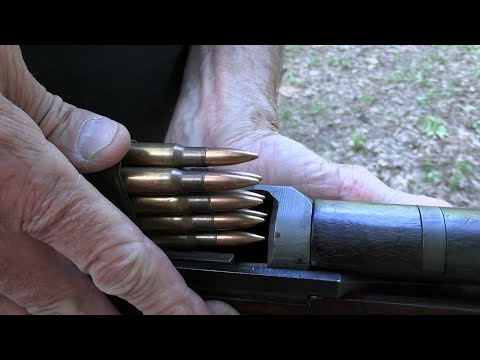
T3E2 Trials .276-Caliber Garand

Published on April 1, 2016
Duration: 25:06

This video provides an expert-level review of the T3E2 Garand trials rifle, presented by Ian McCollum of Forgotten Weapons. It details the rifle's development, its competition against other designs like the Pedersen Rifle, and the reasons for its ultimate rejection in favor of the M1 Garand in .30-06 Springfield. Key technical differences and historical context are thoroughly explored.

Quick Summary

The T3E2 Garand, chambered in .276 Pedersen, was a near-adoption US service rifle rejected in 1932 due to logistical concerns. Ian McCollum highlights its lighter weight, 10-round capacity, and innovative gas trap system, contrasting it with the M1 Garand.

Chapters

  1. 00:00Introduction to the T3E2 Garand
  2. 00:46Early Development and Gas Operation
  3. 02:081929 Rifle Trials
  4. 03:29Field Testing and Ballistics
  5. 08:14MacArthur's Intervention
  6. 13:58Technical Comparison: T3E2 vs. M1 Garand
  7. 19:43Gas Trap System

Frequently Asked Questions

What was the T3E2 Garand and why wasn't it adopted?

The T3E2 Garand was the final trials version of John Garand's rifle, chambered in .276 Pedersen. It was nearly adopted in 1932 but was rejected due to General Douglas MacArthur's concerns about the logistical challenges of introducing a new caliber alongside existing .30-06 support weapons.

What were the key technical differences between the T3E2 Garand and the M1 Garand?

The T3E2 Garand was lighter, slightly shorter, and featured a 10-round en bloc clip compared to the M1 Garand's 8-round capacity. Internally, the T3E2 used a straight operating rod, while the M1 Garand required a bent 'dog-leg' rod.

What was the significance of the .276 Pedersen caliber in the Garand trials?

The .276 Pedersen caliber offered reduced recoil and lighter ammunition compared to .30-06 Springfield. Field tests showed it had comparable ballistic trajectory and allowed for faster follow-up shots, making it a favorable option for infantry use.

What was the 'gas trap' system used on the T3E2 Garand?

The T3E2 Garand employed a 'gas trap' system at the muzzle to operate the action, avoiding the need to drill into the barrel. However, this design led to significant carbon fouling as the gas cooled in the expansion chamber.

More Reviews Videos You Might Like

More from Forgotten Weapons

View all →