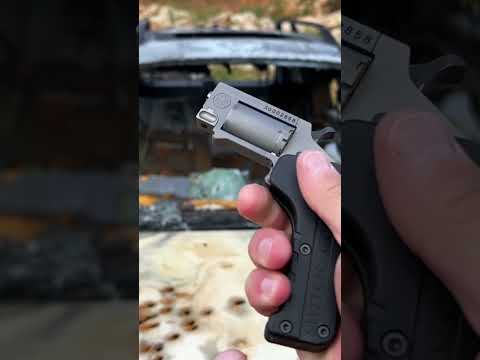
.22short Vs Ham Target πŸ·πŸ–

Published on September 1, 2024
Duration: 0:13

This video from 704 Tactical demonstrates a point-blank terminal ballistics test using a North American Arms .22 Short Mini-Revolver fired into a Smithfield ham. The experiment aims to visually assess the penetration capabilities of the .22 Short cartridge from a micro-revolver. The instructor, established in firearms review, showcases proper handling and focuses on the damage assessment, confirming the round passed completely through the ham.

Quick Summary

A terminal ballistics test was conducted using a North American Arms .22 Short Mini-Revolver fired point-blank into a Smithfield ham. The experiment demonstrated that the .22 Short round, fired from the 1.125-inch barrel, successfully penetrated the ham completely, offering a visual assessment of its performance.

Chapters

  1. 00:00Introduction and Setup
  2. 00:05The Shot
  3. 00:08Damage Assessment

Frequently Asked Questions

What firearm was used in the .22 Short ham test?

The video features a North American Arms (NAA) mini-revolver chambered in .22 Short caliber. Specifically, the model appears to be the NAA-22S, known for its compact size and 5-round capacity.

What was the purpose of shooting a ham with a .22 Short?

The primary purpose was to conduct a point-blank terminal ballistics test, visually demonstrating the penetration and damage capabilities of the .22 Short cartridge fired from a micro-revolver into an organic medium.

Did the .22 Short round penetrate the ham completely?

Yes, the test showed that the .22 Short round fired from the NAA Mini-Revolver at point-blank range passed completely through the Smithfield ham, including its plastic packaging.

What are the technical specifications of the NAA .22 Short Mini-Revolver?

The North American Arms .22 Short Mini-Revolver features a 1.125-inch barrel, a 5-round capacity, and weighs approximately 4.1 oz. Its MSRP typically ranges from $240 to $260.

More Tactical & Gear Videos You Might Like

More from 704 TACTICAL

View all β†’