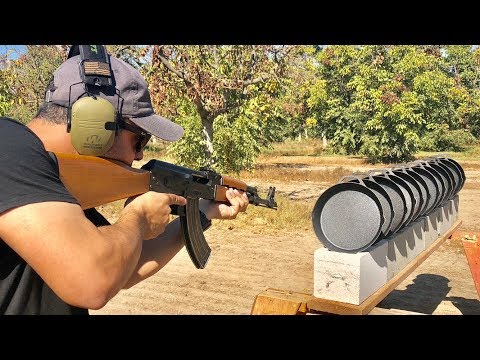
500 MAGNUM & 357 MAGNUM VS ARMOR

Published on February 1, 2017
Duration: 3:47

This video from Edwin Sarkissian, a recognized firearms content creator, tests the ballistic resistance of homemade armor against powerful handgun calibers. The armor, composed of Line-X, sheet metal, Kevlar, and ceramic tile, successfully stopped both a .500 Magnum and a .357 Magnum round, demonstrating its effectiveness against common handgun threats.

Quick Summary

Homemade armor, built with Line-X, sheet metal, Kevlar, and ceramic tile, was tested against .500 Magnum and .357 Magnum rounds. Both calibers were stopped, with the .500 Magnum causing a significant bulge and the .357 Magnum resulting in less deformation, demonstrating the armor's effectiveness.

Chapters

  1. 00:00Introduction
  2. 00:17Armor Composition
  3. 00:53.500 Magnum Test
  4. 01:31.500 Magnum Results
  5. 02:28.357 Magnum Test
  6. 02:51Conclusion & Previous Results

Frequently Asked Questions

What materials were used to construct the homemade armor plate tested in the video?

The armor plate was constructed using a combination of Line-X coating, 18-gauge sheet metal, Kevlar, and ceramic tile. This multi-layer approach was designed to provide ballistic resistance.

Did the .500 Magnum round penetrate the homemade armor?

No, the .500 Magnum round, specifically an Underwood 350-grain Extreme Penetration load, was stopped by the armor. It caused a significant bulge on the back but did not penetrate the plate.

How did the .357 Magnum perform against the armor compared to the .500 Magnum?

The .357 Magnum round, an Underwood 125-grain FMJ, was also stopped by the armor. Notably, it caused even less deformation to the armor plate than the .500 Magnum round did.

What firearms were used in the armor penetration test?

The firearms used were a Smith & Wesson .500 Magnum revolver for the first test and a Smith & Wesson .357 Magnum revolver for the second test.

More Tactical & Gear Videos You Might Like

More from Edwin Sarkissian

View all →