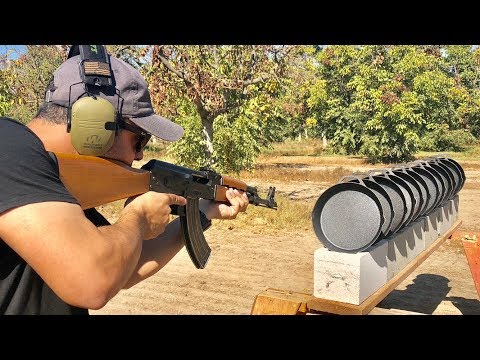
Bowling Ball cannon vs oxygen tank

Published on December 15, 2022
Duration: 10:49

This video details an experimental ballistics test by Edwin Sarkissian, showcasing a custom Bowling Ball Cannon against high-pressure oxygen tanks. The expert instructor demonstrates the loading and firing process, highlighting the risks and technical considerations. The experiment reveals that while the oxygen tank casing is highly durable, the valve is the critical failure point, leading to a dramatic rocket-like propulsion when ruptured.

Quick Summary

Expert instructor Edwin Sarkissian demonstrates a custom Bowling Ball Cannon's power against high-pressure oxygen tanks. The experiment reveals the tank's casing is highly durable, but the valve is the critical failure point. A precise shot sheared the valve, causing the tank to rocket across the terrain due to rapid gas decompression.

Chapters

  1. 00:00Introduction & Context
  2. 00:44Loading the Cannon
  3. 01:57Projectile and Aiming
  4. 03:43First Shot Analysis
  5. 05:49Second Shot Setup
  6. 07:33Second Shot and Rocket Effect
  7. 09:21Conclusion

Frequently Asked Questions

What was the outcome of the Bowling Ball Cannon test against the oxygen tank?

The first shot hit the shoulder of the oxygen tank, knocking it over but failing to rupture the casing. The second shot, aimed precisely at the valve, successfully sheared it off, causing the tank to rocket across the landscape due to rapid gas decompression.

How was the Bowling Ball Cannon loaded for the experiment?

The cannon was loaded with a long fuse, a charge of black powder supplemented with pistol powder for increased energy, and tissue used as wadding. A standard bowling ball served as the projectile.

What is the critical failure point of a high-pressure oxygen tank when subjected to ballistic impact?

Based on the experiment, the valve assembly is the critical failure point. While the thick steel casing proved highly durable against the bowling ball projectile, the valve was successfully sheared off, leading to rapid decompression and propulsion.

What safety considerations are important when conducting experimental ballistics like this?

Safety is paramount. This includes ensuring a clear firing zone, being aware of potential ricochets, handling explosive materials with extreme caution, and wearing appropriate personal protective equipment like eye and ear protection.

More Tactical & Gear Videos You Might Like

More from Edwin Sarkissian

View all →