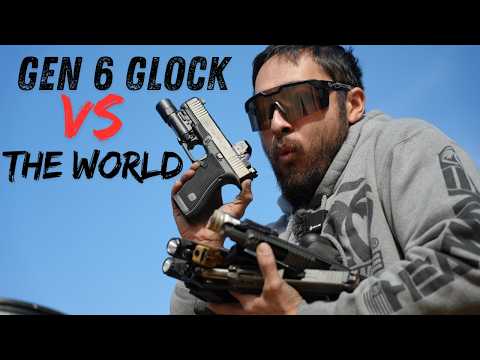
Now We Know Why The US Army REALLY Said NO To Glock!

Published on March 31, 2025
Duration: 8:04

The US Army rejected the Glock 19X for the XM17 modular handgun trials primarily because it did not meet the requirement for a modular handgun system. While Glock offered some modularity by allowing slide and grip swaps between models like the 17 and 19, it required purchasing multiple complete firearms. In contrast, the Sig P320's modularity was based on a removable trigger pack, allowing different grip sizes and slide lengths to be configured from a single firearm with additional components, making it a more cost-effective and compliant solution for the Army's needs.

Quick Summary

The US Army rejected the Glock 19X for the XM17 trials primarily because it did not meet the requirement for a true modular handgun system. While Glock offered some slide and grip interchangeability, it did not align with the Army's vision of a single platform adaptable to various sizes with interchangeable core components like a trigger pack, making the Sig P320 a more compliant and cost-effective choice.

Chapters

  1. 00:09XM17 Trials Introduction
  2. 00:43XM17 Competition Details
  3. 01:17Trial Requirements Explained
  4. 01:45Glock 19X Rejection Speculation
  5. 02:02Thumb Safety Discussion
  6. 02:21Cost Factor Analysis
  7. 03:00The Modularity Issue
  8. 03:38Glock's Modularity Approach
  9. 04:02Sig P320 Modularity Advantage
  10. 04:22Cost Comparison: Sig vs. Glock
  11. 05:26Requirement vs. Performance
  12. 05:42Final Reasons for Rejection

Frequently Asked Questions

What were the main reasons the US Army rejected the Glock 19X for the XM17 trials?

The primary reason the US Army rejected the Glock 19X was its failure to meet the requirement for a true modular handgun system. While Glock offered some slide and grip interchangeability, it did not align with the Army's vision of a single platform adaptable to various sizes with interchangeable core components like a trigger pack.

How did the Sig P320 meet the US Army's modularity requirement better than the Glock 19X?

The Sig P320's design featured a removable trigger pack, which served as the firearm's serialized component. This allowed users to swap grip modules and slide assemblies to create different configurations, fulfilling the Army's need for a truly modular system. The Glock 19X's approach required purchasing multiple complete firearms for different configurations.

Was cost a significant factor in the US Army's decision between the Glock 19X and Sig P320?

Yes, cost was a significant factor. The Sig P320 offered a more cost-effective modular solution, allowing for multiple configurations at an estimated $1,100 per soldier. The Glock 19X's approach would have required purchasing three separate firearms, leading to a much higher estimated cost of $1,800 per soldier.

What were some of the key performance requirements for the US Army's XM17 handgun trials?

Key performance requirements included a 90% hit rate at a 4-inch circle out to 50 meters, improved ergonomics, better recoil management for faster follow-up shots, an accessory rail, ambidextrous controls, the capability to fire higher-pressured rounds than the Beretta 92, and a mean time between failures of 10,000 rounds.

Related News

All News →

More Tactical & Gear Videos You Might Like

More from God Family and Guns

View all →